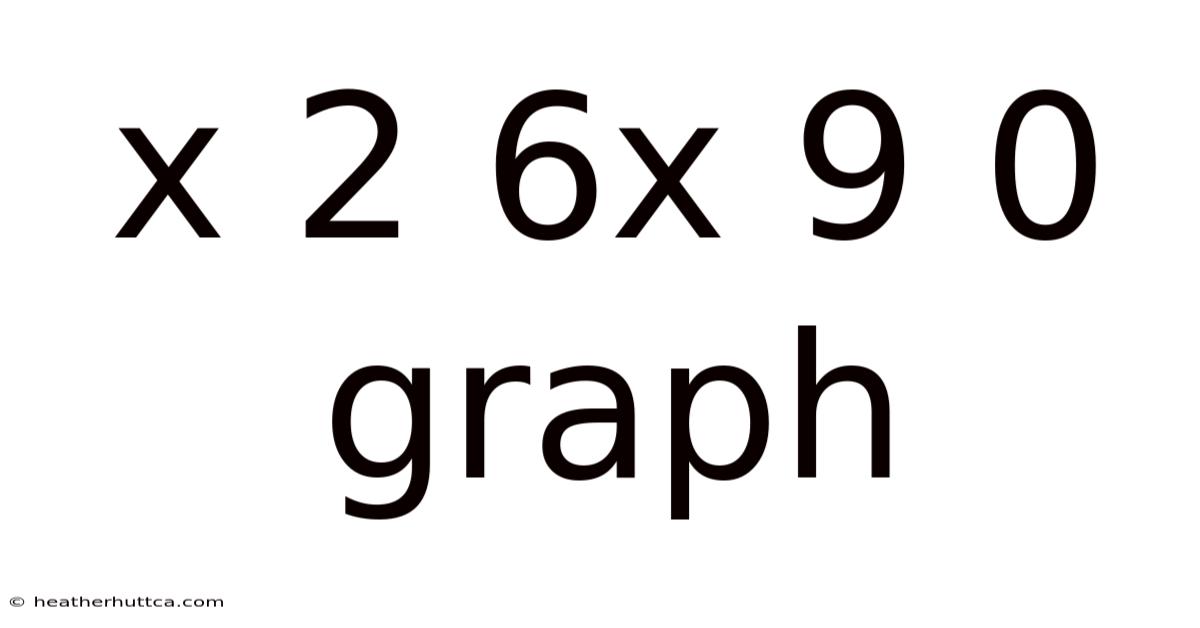
The graph of the equation x² + 6x + 9 = 0 is a fundamental example of a quadratic function’s visual representation. That said, the equation x² + 6x + 9 = 0 is not just a mathematical expression but a gateway to grasping concepts like vertex, axis of symmetry, and the behavior of quadratic functions. Understanding how to plot and interpret this graph is essential for students and learners exploring algebra and coordinate geometry. By analyzing its graph, readers can gain insights into how algebraic equations translate into visual patterns, making abstract concepts more tangible. Think about it: this equation, when graphed, forms a parabola that intersects the x-axis at a single point, reflecting its unique mathematical properties. This article will dig into the steps to graph this equation, the scientific principles behind its shape, and common questions that arise when studying such graphs Took long enough..
To graph the equation x² + 6x + 9 = 0, the first step is to solve for its roots. This involves finding the values of x that satisfy the equation. That said, the equation can be factored as (x + 3)² = 0, which reveals that the only solution is x = -3. This means the graph touches the x-axis at the point (-3, 0). Since the equation has a repeated root, the parabola does not cross the x-axis but instead just touches it at this point. On top of that, this is a key characteristic of quadratic equations with a discriminant of zero. Once the root is identified, the next step is to determine the vertex of the parabola. The vertex form of a quadratic equation is y = a(x - h)² + k, where (h, k) is the vertex. For x² + 6x + 9, completing the square transforms it into y = (x + 3)², indicating the vertex is at (-3, 0). This confirms that the vertex coincides with the root, a unique feature of this particular equation.
Real talk — this step gets skipped all the time.
The axis of symmetry is another critical element of the graph. In practice, in this case, a = 1, b = 6, so the axis of symmetry is x = -6/(2*1) = -3. But this symmetry is visually evident in the graph, as the parabola opens upward and is perfectly balanced around this line. This vertical line passes through the vertex and divides the parabola into two mirror-image halves. Since the vertex is at (-3, 0), the axis of symmetry is the line x = -3. In practice, for any quadratic equation in standard form y = ax² + bx + c, the axis of symmetry is given by x = -b/(2a). Understanding the axis of symmetry helps in plotting additional points and ensuring the graph’s accuracy.
To complete the graph, it is helpful to plot additional points around the vertex. And choosing x-values close to -3, such as -4 and -2, allows for a clearer picture of the parabola’s shape. On the flip side, substituting x = -4 into the equation gives y = (-4)² + 6*(-4) + 9 = 16 - 24 + 9 = 1. Even so, similarly, substituting x = -2 yields y = (-2)² + 6*(-2) + 9 = 4 - 12 + 9 = 1. Think about it: these points, (-4, 1) and (-2, 1), lie on either side of the vertex and confirm the parabola’s upward opening. Connecting these points with a smooth curve results in a parabola that touches the x-axis at (-3, 0) and rises symmetrically on both sides. This process illustrates how algebraic manipulation and coordinate plotting work together to create a visual representation of the equation.
The scientific explanation behind the graph of x² + 6x + 9 = 0 lies in the properties of quadratic functions. A quadratic equation in the form ax² + bx + c = 0 always produces a parabola when graphed. The direction in which the parabola opens depends on the coefficient of x². Since the coefficient here is positive (a = 1), the parabola opens upward. That's why the discriminant of the equation, calculated as b² - 4ac, determines the nature of the roots. For x² + 6x + 9, the discriminant is 6² - 419 = 36 - 36 = 0 And it works..
A discriminant of zero indicates that the equation has exactly one real root, which is repeated or double-root. This geometric interpretation aligns perfectly with what we observe on the graph: the parabola touches the x-axis at a single point rather than crossing through it. In contrast, a positive discriminant would result in two distinct real roots where the parabola intersects the x-axis at two separate points, while a negative discriminant would yield complex roots with no x-intercepts at all. The case of x² + 6x + 9 = 0 represents the precise boundary between these scenarios, making it a mathematically significant example Small thing, real impact..
Short version: it depends. Long version — keep reading.
The practical applications of understanding this specific quadratic function extend across various fields. Think about it: in physics, equations of this form describe projectile motion under certain conditions, where the discriminant zero indicates the exact moment an object reaches its maximum height before descending. In engineering, such equations appear in optimization problems, helping determine minimum or maximum values for design parameters. The parabolic shape itself is fundamental to satellite dishes, reflective properties of telescopes, and even the trajectory of water in a fountain.
Comparing this equation to other quadratics further highlights its unique nature. When graphed alongside y = x² + 6x + 8, which has a positive discriminant of 4, the difference becomes apparent: the latter crosses the x-axis at two points, creating a traditional "U" shape that passes through the coordinate plane. Conversely, equations with negative discriminants, such as x² + 6x + 10, float entirely above the x-axis without touching it. The equation x² + 6x + 9 = 0 serves as the perfect transition between these behaviors, demonstrating the delicate balance in quadratic systems Most people skip this — try not to..
To wrap this up, the graph of y = x² + 6x + 9 represents a fundamental case in the study of quadratic functions. The fact that this equation can be factored as (x + 3)² = 0 makes it an ideal teaching tool for understanding perfect square trinomials and the concept of repeated roots. Its single root at x = -3, vertex at (-3, 0), and axis of symmetry along x = -3 collectively illustrate the elegant symmetry inherent in mathematics. Whether encountered in an algebra classroom or applied to real-world problems, this quadratic equation demonstrates how a single mathematical expression can embody multiple interconnected concepts, from algebraic manipulation to geometric interpretation, ultimately revealing the beautiful precision of mathematical relationships.
Exploring the nuances of this quadratic equation deepens our appreciation for its structural elegance. Consider this: the repeated root not only simplifies calculations but also underscores the importance of the discriminant in shaping the graph’s behavior. This example serves as a reminder of how abstract mathematical ideas manifest tangibly in visual forms, guiding both theoretical understanding and practical solutions. As we analyze such cases, we recognize the recurring themes that connect different branches of mathematics, reinforcing the interconnectedness of concepts.
Understanding these relationships equips us with the tools to tackle more complex problems, whether in advanced calculus or applied sciences. The ability to discern patterns—such as the transition from crossing to touching the x-axis—highlights the predictive power of mathematical models. By engaging with these ideas, we not only enhance our analytical skills but also cultivate a deeper respect for the coherence of mathematical thought Still holds up..
In essence, this quadratic serves as a microcosm of broader mathematical principles, illustrating how precision in form leads to clarity in outcome. Embracing such insights strengthens our grasp of algebra and its far-reaching implications. The journey through this equation ultimately affirms the value of precision and pattern recognition in mathematical exploration.
So, to summarize, the significance of x² + 6x + 9 extends beyond its coefficients; it embodies the harmony between numbers and geometry, offering profound lessons for learners and practitioners alike That's the part that actually makes a difference..
