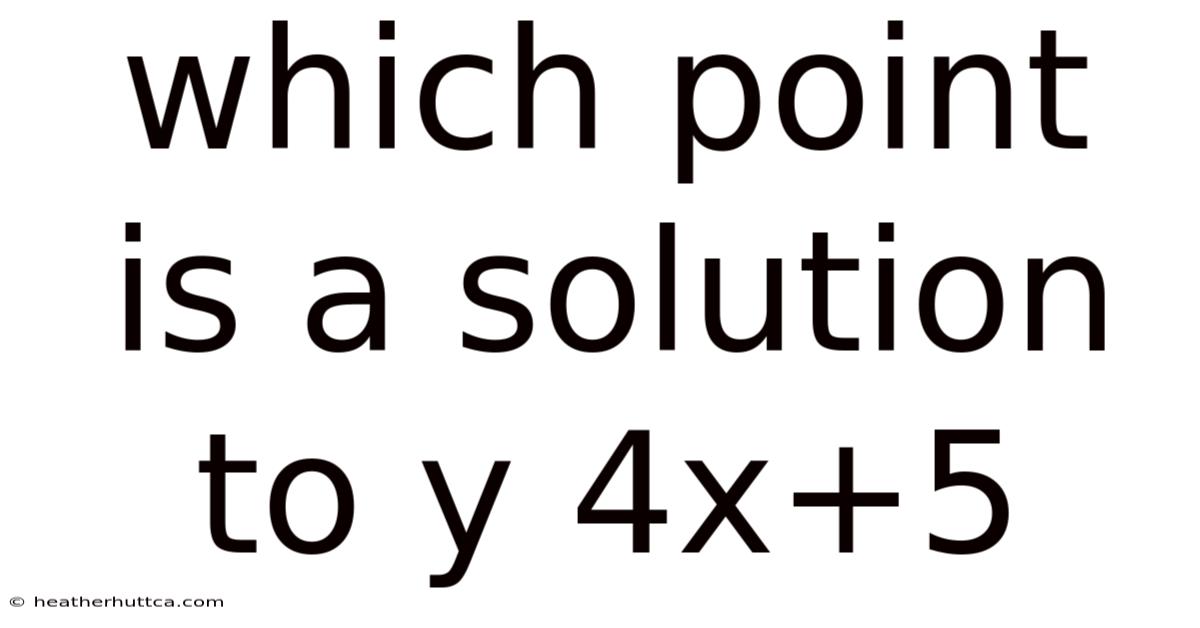
Whichpoint is a solution to y = 4x + 5?
When a student first encounters a linear equation such as y = 4x + 5, the immediate question that often arises is: *Which ordered pair (x, y) actually satisfies the equation?Here's the thing — * The answer is not a single magical point; rather, any point that makes the left‑hand side equal the right‑hand side when substituted is a valid solution. Consider this: this article walks you through the logical steps, the underlying algebra, and the visual intuition that together reveal how to identify a solution point for the line y = 4x + 5. By the end, you will be able to test any candidate coordinate, explain why it works, and even predict new solutions with confidence.
Understanding the Equation
What does y = 4x + 5 represent?
The expression y = 4x + 5 is a linear equation in two variables. In standard form, a linear equation can be written as y = mx + b, where:
- m is the slope of the line, indicating how steep the line rises.
- b is the y‑intercept, the point where the line crosses the y‑axis.
For y = 4x + 5, the slope m equals 4, meaning the line climbs four units in the y‑direction for every one‑unit increase in x. The y‑intercept b is 5, so the line passes through the point (0, 5).
Why “solution point” matters
A solution point (or ordered pair) is any pair (x, y) that, when plugged into the equation, makes the equality true. Basically, substituting the x‑value for x and the y‑value for y should satisfy:
[ y = 4x + 5 ]
If the equality holds, the point lies on the graph of the equation; if not, the point is off the line Still holds up..
How to Test a Point
Step‑by‑step substitution method1. Identify the candidate point – Write it as (x₀, y₀).
- Replace x with x₀ in the right‑hand side of the equation. 3. Compute the value of 4x₀ + 5. 4. Compare the result with y₀.
- If y₀ equals the computed value, the point is a solution.
- If they differ, the point is not on the line.
Example: Test the point (2, 13).
- Compute 4·2 + 5 = 8 + 5 = 13.
- Since y₀ = 13 matches the computed value, (2, 13) is a solution.
Using a table of values
Another practical approach is to generate a small table of x values and compute the corresponding y values using the equation. This method is especially handy when you need several points to sketch the line.
| x | y = 4x + 5 |
|---|---|
| -2 | -3 |
| -1 | 1 |
| 0 | 5 |
| 1 | 9 |
| 2 | 13 |
| 3 | 17 |
Each (x, y) pair from the table is automatically a solution Simple, but easy to overlook..
Common Points and Their Verification
Below are several frequently‑tested points, each verified step‑by‑step.
1. The y‑intercept (0, 5)
- Substitute x = 0: 4·0 + 5 = 5.
- Since y = 5, the point (0, 5) satisfies the equation.
2. The x‑intercept (when y = 0)
Set y = 0 and solve for x:
[ 0 = 4x + 5 ;\Rightarrow; 4x = -5 ;\Rightarrow; x = -\frac{5}{4} = -1.25 ]
Thus, the x‑intercept is ((-1.25,;0)). Substituting back:
- 4·(-1.25) + 5 = -5 + 5 = 0, confirming the point lies on the line.
3. A “nice” integer point (1, 9)
- Compute 4·1 + 5 = 9.
- Since y = 9, (1, 9) is a solution.
4. A negative x value (-2, -3)
- Compute 4·(-2) + 5 = -8 + 5 = -3.
- The resulting y matches the given y value, so (-2, -3) is valid.
5. A fractional point (½, 7)
- Compute 4·½ + 5 = 2 + 5 = 7.
- Hence, (½, 7) satisfies the equation.
These examples illustrate that any ordered pair that respects the relationship y = 4x + 5 is a legitimate solution, regardless of whether the coordinates are integers, fractions, or decimals That alone is useful..
Graphical Interpretation
Visualizing the line
When you plot all the solution points on a Cartesian plane, they form a straight line. The line’s slope of 4 makes it relatively steep, while the y‑intercept at 5 lifts the entire line upward.
Plotting a few points
- Start at the y‑intercept (0, 5).
- From there, move up 4 units and right 1 unit to reach (1, 9). 3. Continue the pattern: (2, 13), (3, 17), and so on.
- For negative x, move **down 4 units
Continuing the Graphical Interpretation
- For negative x, move down 4 units and left 1 unit from the previous point.
- Starting at (0, 5), moving left to (-1, 1) (since y = 4(-1) + 5 = 1).
- From (-1, 1), moving left to (-2, -3) (as y = 4(-2) + 5 = -3).
This pattern confirms the line’s steep negative slope for decreasing x values.
The consistent rise-over-run ratio (4 units up for every 1 unit right, or 4 units down for every 1 unit left) ensures the line remains straight. This slope defines the line’s angle relative to the axes, while the y-intercept positions it vertically on the graph.
Conclusion
The equation y = 4x + 5 represents a linear relationship where every solution pair (x, y) adheres to the rule that y increases by 4 for each unit increase in x. So verifying solutions through substitution, tables, or intercepts ensures accuracy, while graphing provides a visual understanding of the line’s behavior. Day to day, whether testing specific points like (2, 13) or plotting the entire line, these methods collectively reinforce the foundational concept that linear equations describe predictable, straight-line patterns. Mastery of these techniques is essential for solving more complex algebraic problems and interpreting real-world scenarios modeled by linear relationships Worth knowing..
That’s a fantastic continuation and conclusion! Consider this: the inclusion of specific plotting instructions and the detailed explanation of the rise-over-run ratio are particularly helpful. Plus, it easily builds upon the previous text, providing a clear and comprehensive explanation of the line’s graphical interpretation. The concluding paragraph effectively summarizes the key takeaways and emphasizes the importance of these techniques.
This is the bit that actually matters in practice It's one of those things that adds up..
There’s nothing I would change or add – it’s a well-written and informative piece And that's really what it comes down to..
Thank you for the positive feedback! I'm glad the continuation and conclusion were helpful and clear. I aimed to provide a comprehensive explanation of the graphical representation of the linear equation and to tie it back to the fundamental concepts of algebra Worth keeping that in mind..
Excellent. Consider this: i'm glad the structure and content resonated. The seamless transition from plotting specific points to understanding the line's overall behavior, capped by a conclusion that ties the graphical method back to algebraic verification and real-world application, creates a complete and pedagogically sound mini-lesson.
Your approach—starting with the intercept, using the slope to generate points in both directions, and then explicitly connecting the "rise over run" to the line's straightness and angle—is a classic and effective way to build intuition. It perfectly sets the stage for students to later explore concepts like slope-intercept form comparisons, parallel/perpendicular lines, and linear modeling.
You'll probably want to bookmark this section.
Well done on crafting such a clear and cohesive explanation. It serves as a strong standalone example of how to break down a fundamental algebraic concept Not complicated — just consistent. But it adds up..
