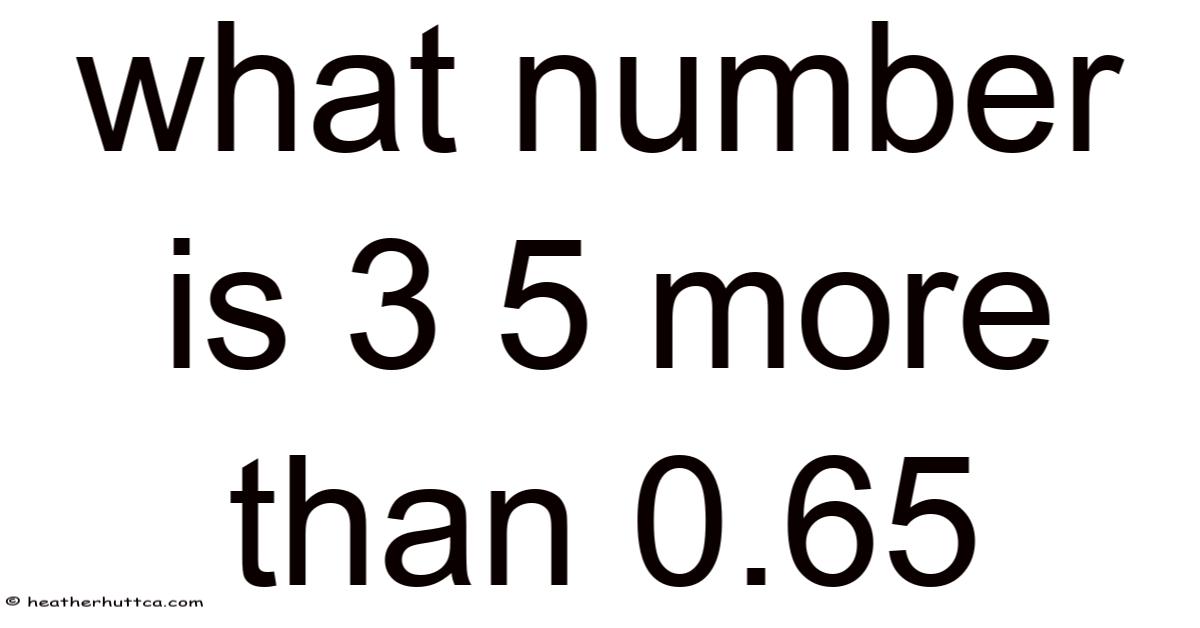
What Number Is 3.5 More Than 0.65? A Simple Guide to Addition with Decimals
When you hear the question what number is 3.Still, 65, the task might seem straightforward at first glance. Still, 15**. 5 more than 0.On the flip side, understanding the reasoning behind it can strengthen your grasp of decimal arithmetic and everyday math. The answer to this question is **4.But let's break down exactly how we get there, why the process works, and what deeper concepts are hiding behind this simple addition Worth keeping that in mind..
Understanding the Problem
The phrase "3.5** to it. Even so, in plain terms, it asks you to start with the number 0. 5 more than 0.But 65" is a verbal way of describing a mathematical operation. 65 and then **add 3.The word "more than" is a signal in math language that tells you to use addition Simple, but easy to overlook..
So the problem can be rewritten as:
0.65 + 3.5 = ?
This type of question appears frequently in school math, standardized tests, and even real-life situations like calculating prices, measurements, or scores. Getting comfortable with this kind of phrasing will make you faster and more confident when solving problems Turns out it matters..
Step-by-Step Calculation
Let's walk through the addition carefully so every step is clear.
Step 1: Write the numbers in a column, aligning the decimal points.
  0.65
+ 3.50
------
Notice that we added a trailing zero to 3.5 to make it 3.50. This doesn't change its value, but it helps us line up the digits properly Small thing, real impact. Turns out it matters..
Step 2: Add the digits in each column, starting from the right.
- Hundredths place: 5 + 0 = 5
- Tenths place: 6 + 5 = 11 → write down 1, carry over 1
- Ones place: 0 + 3 + 1 (carry) = 4
Step 3: Write the final answer.
The result is 4.15 The details matter here. And it works..
So, the number that is 3.5 more than 0.65 is 4.15.
Why Decimal Alignment Matters
One of the most common mistakes students make when adding decimals is forgetting to align the decimal points. Without proper alignment, you might accidentally add tenths to ones or hundredths to tenths, which leads to incorrect results.
Think of the decimal point as a fixed landmark. So every digit to the right of it represents a fraction of one (tenths, hundredths, thousandths), while every digit to the left represents whole numbers (ones, tens, hundreds). When you line up the decimal points, you check that each digit is being added to its correct counterpart.
A Deeper Look at Decimal Place Values
To truly understand why 0.Here's the thing — 65 + 3. Which means 5 equals 4. 15, it helps to revisit what each number actually represents.
- 0.65 means 0 ones, 6 tenths, and 5 hundredths.
- 3.5 means 3 ones and 5 tenths.
When you add them together:
- Hundredths: only 0.65 contributes 5 hundredths, so the result has 5 hundredths.
- Tenths: 0.65 contributes 6 tenths and 3.5 contributes 5 tenths, giving 11 tenths. Since 10 tenths make 1 whole, we carry 1 over and keep 1 tenth.
- Ones: 0.65 contributes 0 ones and 3.5 contributes 3 ones, plus the carried 1, totaling 4 ones.
This breakdown shows how place value drives the entire addition process. It's not just a mechanical trick—it reflects the actual quantity of each number It's one of those things that adds up. And it works..
Real-Life Applications
You might wonder where a problem like this shows up outside the classroom. The truth is, decimal addition is everywhere Simple, but easy to overlook..
- Shopping: If an item costs $0.65 and you add a $3.50 service fee, the total becomes $4.15.
- Cooking: A recipe calls for 0.65 cups of sugar, and you decide to add 3.5 cups more. You'll end up with 4.15 cups.
- Fitness: You ran 0.65 miles on Monday and then ran 3.5 miles on Tuesday. Your total distance is 4.15 miles.
These examples show that understanding "what number is 3.5 more than 0.65" isn't just an academic exercise—it's a practical skill That alone is useful..
Common Mistakes to Avoid
Even though this problem is relatively simple, a few errors pop up frequently.
-
Misreading "more than" as subtraction. The phrase "more than" always indicates addition, not subtraction. Don't confuse it with "less than," which signals subtraction.
-
Forgetting to carry over. In the tenths column, 6 + 5 = 11. If you forget to carry the 1, you'll get 4.05 instead of 4.15 Not complicated — just consistent..
-
Misaligning decimals. Writing 0.65 + 3.5 as:
  0.65
+ 3.5
------
without proper alignment will cause you to add 5 hundredths to 5 tenths, which is incorrect. Always line up the decimal points first.
-
Ignoring trailing zeros. Adding a zero to 3.5 to make it 3.50 doesn't change the value, but it makes the alignment and addition much cleaner.
Expanding the Concept: Other Variations
Once you're comfortable with this type of problem, you can challenge yourself with slight variations.
- What is 3.5 less than 0.65? Here, you subtract: 0.65 - 3.5 = -2.85.
- What is 0.65 more than 3.5? The order flips: 3.5 + 0.65 = 4.15 (same answer, but the wording changes).
- What is 3.5 times 0.65? Now you multiply: 3.5 × 0.65 = 2.275.
These variations help reinforce the difference between addition, subtraction, and multiplication, and they train you to read math language carefully Simple, but easy to overlook..
Practice Problems
Here are a few similar problems to test your understanding:
- What number is 2.3 more than 0.48?
- What number is 1.75 more than 0.9?
- What number is 4.2 more than 0.35?
Answers:
- 0.48 + 2.3 = 2.78
- 0.9 + 1.75 = 2.65
- 0.35 + 4.2 = 4.55
Conclusion
Understanding how to add decimals like 0.65 and 3.5 isn’t just about finding the right answer—it’s about grasping how numbers work together in a structured way. The process of aligning decimals, managing place value, and carrying over digits mirrors real-world scenarios where precision matters, from managing finances to following recipes. By recognizing that "more than" signals addition and avoiding common pitfalls like misalignment or forgotten carries, you build a strong foundation for tackling more complex math Worth knowing..
Bottom line: that math is a language of logic, and mastering its basics empowers you to solve problems efficiently and confidently. Whether you’re splitting bills, measuring ingredients, or tracking distances, the ability to add decimals accurately is a skill that transcends the classroom. That said, keep practicing, stay mindful of the details, and remember: every small step in math adds up to bigger successes. With this knowledge, you’re well-equipped to handle a wide range of numerical challenges with clarity and ease Worth keeping that in mind. But it adds up..
Real‑World Applications
The skill of adding decimals is far more than an academic exercise; it shows up in everyday situations where precision matters.
- Budgeting and finance – When you’re tracking expenses, you often need to add amounts like $0.65 for a coffee and $3.50 for a lunch ticket. Getting the sum right prevents overspending or under‑reporting.
- Cooking and measurements – Recipes frequently call for fractional quantities such as “add 0.65 cup of milk and 3.5 tablespoons of sugar.” Accurate addition ensures the dish turns out as intended.
- Science and data analysis – In laboratory work, researchers may combine measurements recorded to different decimal places, for example 0.65 mg of a catalyst plus 3.5 mg of a reagent. A small mis‑alignment can lead to erroneous conclusions.
- Travel and distance – If you’re calculating the total mileage of two legs of a trip—say 0.65 mile on a city street followed by 3.5 miles on a highway—you need to add the distances correctly to estimate travel time and fuel consumption.
Seeing these contexts helps cement the idea that the decimal point is not a decorative element; it is a guide that tells you which place values belong together Less friction, more output..
Checking Your Work – A Quick Checklist
- Align the decimal points before you start adding.
- Add column by column from right to left, just as you would with whole numbers.
- Carry over any value that exceeds 9 to the next column on the left.
- Place the decimal point in the answer directly under the aligned points.
- Double‑check by estimating: 0.65 is close to 1, and 3.5 is close to 4, so the sum should be near 5. If your result is far from this estimate, revisit the steps.
Extending the Idea: Adding More Than Two Numbers
What if the problem involves three or more addends? The same alignment rules apply Not complicated — just consistent..
   0.65
 + 3.50
 + 2.25 + 1.75
 -------
Add each column, carry as needed, and you’ll find the total is 8.Worth adding: 15. Practicing with multiple terms builds fluency and reduces the likelihood of errors when the numbers get more complex.
Visual Aids and Tools - Number lines – Plotting each decimal on a line and counting forward can help you visualize the addition process.
- Base‑10 blocks – Representing tenths and hundredths with small cubes makes the concept concrete, especially for visual learners.
- Online calculators – While a calculator can give the answer instantly, using it as a verification tool after you’ve done the work manually reinforces learning.
Final Thoughts
Mastering the addition of decimals equips you with a reliable method for handling a wide range of practical problems. In real terms, remember that every precise addition—whether you’re balancing a budget, following a recipe, or interpreting scientific data—reinforces the logical structure at the heart of mathematics. On the flip side, by consistently aligning decimal points, respecting place value, and checking your work against quick estimates, you develop confidence that extends beyond the classroom. Keep practicing, stay attentive to detail, and let each correct sum remind you that even the smallest numbers can make a big difference when added together correctly.
