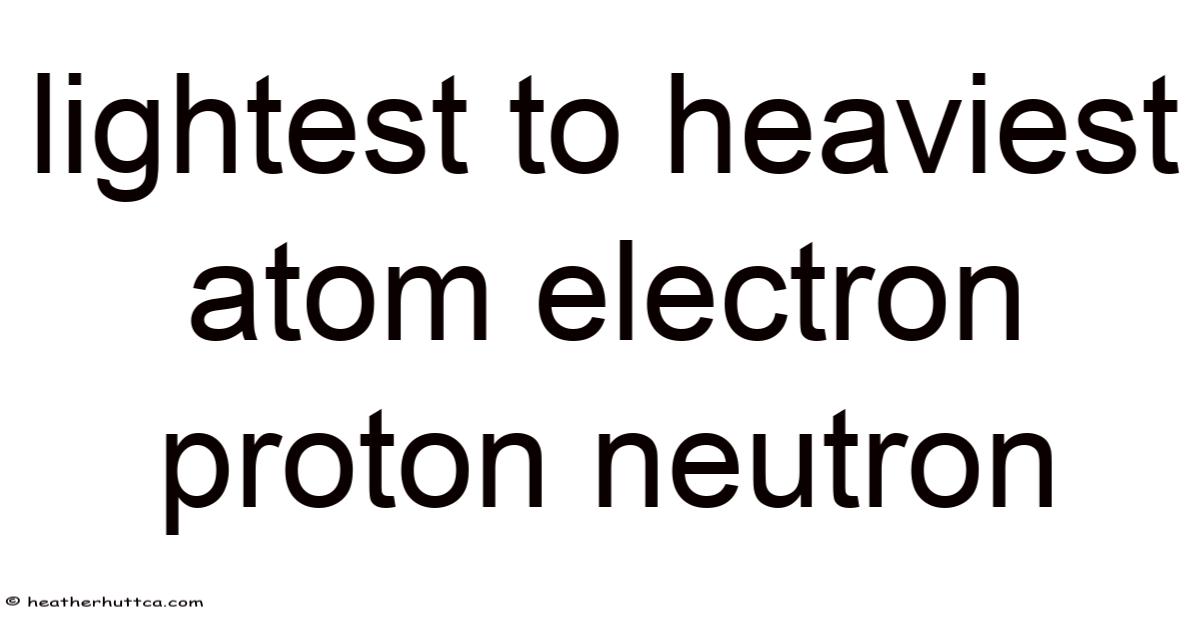
The journey through the atomic universe unfolds like a grand tapestry woven from the fundamental threads of matter and energy, revealing a spectrum that spans from the simplest building blocks to the most complex structures of existence. Day to day, at the heart of this progression lie three indispensable components—electrons, protons, and neutrons—that collectively define the identity of every element on the periodic table. Yet beneath their roles lie mysteries that challenge our understanding of physics, chemistry, and the very fabric of reality itself. Exploring the lightest to the heaviest atoms through these components unveils not only the diversity of matter but also the underlying principles that govern transformation, stability, and evolution. Still, from hydrogen’s simplicity to the involved compositions of elements like uranium, this exploration walks through how protons anchor nuclei, neutrons contribute to stability, and electrons dictate chemical behavior, forming a cohesive narrative that bridges science and perception. Such a journey demands precision, clarity, and an appreciation for both the elegance of natural laws and the complexity they reveal, inviting readers to ponder their place within an ever-expanding cosmos.
Central to this exploration is the understanding that atomic structure is a tapestry woven from three primary entities: protons, neutrons, and electrons. Because of that, their abundance and mass directly influence an element’s atomic weight and its place within the periodic table. In practice, for instance, while hydrogen’s nucleus contains a single proton and zero neutrons, its minimal mass and electron count render it the lightest atom overall. Protons, the nuclei’s central nuclei composed of positively charged particles, serve as the anchors that bind atomic cores together. Conversely, elements like lead or uranium, though dense and heavy, boast a higher number of neutrons, amplifying their mass while retaining similar or comparable atomic numbers. Even so, neutrons, often overlooked in their role, complement protons by adding mass without altering charge, thereby allowing isotopes to exist in varying configurations. These two nuclear components, along with electrons, which orbit around nuclei while maintaining stability, form the trifecta that constitutes the building blocks of atoms. Yet their interplay is not merely additive; rather, it is a delicate balance that defines the properties of elements. This progression reveals a fascinating spectrum where mass increases not solely due to neutron count but also influenced by electron configurations, though electrons themselves remain relatively constant across elements of the same group.
The progression from lightest to heaviest atoms necessitates a careful examination of how atomic number—protons—determines the number of electrons each element possesses, while neutron count modulates mass and stability. Because of that, starting with hydrogen, the simplest atom, its nucleus houses one proton and zero neutrons, resulting in a single electron that orbits it, forming the foundation of all other elements. On top of that, as we ascend to helium, adding another proton and two neutrons, its atomic mass jumps significantly, yet the electron count remains consistent, ensuring the same chemical properties as hydrogen. This pattern continues with lithium, where three protons necessitate three electrons, yet the addition of neutrons introduces variability in mass without altering electron count. Worth adding: the trend becomes clearer when examining elements like beryllium, where four protons require four electrons, while the subsequent increase in atomic number leads to heavier nuclei. On the flip side, the most striking leap occurs with elements such as carbon, nitrogen, oxygen, and so forth, where electron configurations expand, enabling diverse chemical behaviors. Here, the interplay between protons and neutrons becomes critical; for instance, neon, with eight protons and eight neutrons, achieves a stable configuration through electron shielding, while fluorine’s higher neutron-to-proton ratio supports its reactivity. Even in heavier elements like uranium, the dominance of neutrons ensures stability despite their increased mass, illustrating how neutron abundance compensates for higher proton numbers.
A deeper layer of complexity emerges when considering isotopes, which arise from variations in neutron counts within a single element’s atomic structure. While isotopes share the same number of protons and electrons, differing neutron numbers result in distinct atomic masses and chemical properties, though their chemical behavior remains nearly identical. This phenomenon underscores the nuanced relationship between nuclear composition and observable phenomena, highlighting
Counterintuitive, but true.
the nuanced balance within atomic nuclei. Take carbon, for instance: its most common isotope, carbon-12, has six neutrons, while carbon-14, a radioactive isotope, contains eight neutrons. Now, though both isotopes participate in identical chemical reactions due to their shared electron configuration, their differing neutron counts grant carbon-14 unique applications in radiocarbon dating, enabling scientists to determine the age of ancient artifacts. But similarly, isotopes like uranium-235 and uranium-238 differ in neutron count, with the former being fissile and important in nuclear energy, while the latter is non-fissile and more abundant in nature. These distinctions illustrate how subtle nuclear variations can yield profound practical consequences, from energy generation to medical imaging, where isotopes like technetium-99m are indispensable in diagnostics.
Beyond isotopes, the stability of heavy elements hinges on the neutron-to-proton ratio, which becomes increasingly skewed as atomic numbers rise. Elements like lead achieve stability through a balanced ratio, whereas heavier elements such as plutonium require even more neutrons to offset proton repulsion, a phenomenon that drives the synthesis of superheavy elements in laboratories. These synthetic elements, often fleeting and unstable, push the boundaries of the periodic table, offering insights into nuclear forces and the limits of matter itself.
At the end of the day, the architecture of atoms—defined by protons, neutrons, and electrons—reveals a harmonious interplay of forces that govern both the physical and chemical world. From the simplicity of hydrogen to the complexity of uranium, each element’s properties emerge from its nuclear composition and electron arrangement. But isotopes further enrich this narrative, demonstrating how minor adjustments in neutron count can yield significant implications for science and technology. Understanding these principles not only illuminates the building blocks of matter but also underscores the elegance of natural laws that shape our universe, from the smallest atoms to the largest cosmic structures.
The subtle dance between protons, neutrons, and electrons also explains why certain elements exhibit multiple oxidation states that are seemingly disparate. Consider iron: its electronic configuration allows it to exist as Fe²⁺ or Fe³⁺, each with distinct magnetic and catalytic properties. Also, yet the underlying reason for this versatility lies in the subtle reorganization of electrons in response to the nuclear charge and the shielding effect of inner shells. Such behavior is not unique to iron; transition metals throughout the d-block display a remarkable range of valences, a feature that has been harnessed in catalysis, metallurgy, and even in the design of advanced materials like high‑entropy alloys Less friction, more output..
Beyond the realm of chemistry, the principles governing atomic structure ripple through physics, biology, and engineering. In astrophysics, for instance, the delicate balance of neutron‑to‑proton ratios determines the pathways of nucleosynthesis in stars, influencing the elemental abundance we observe in the cosmos. In medicine, the same nuclear stability considerations guide the production of therapeutic radionuclides used to target cancer cells with minimal collateral damage. Even the development of quantum technologies—such as atomic clocks and quantum sensors—relies on precise knowledge of electron energy levels and nuclear spin states, which are themselves dictated by the atomic skeleton Simple, but easy to overlook..
Not obvious, but once you see it — you'll see it everywhere.
The ongoing exploration of superheavy elements, synthesized in underground laboratories, further illustrates the frontiers of our understanding. Each new element, often existing for mere milliseconds, challenges existing theoretical models and prompts refinements in our depiction of the strong nuclear force. These fleeting experiments not only expand the periodic table but also test the limits of quantum mechanics and relativistic effects in extreme conditions.
In sum, the architecture of atoms—protons defining elemental identity, neutrons modulating nuclear stability, and electrons orchestrating chemical behavior—forms the cornerstone of modern science. In real terms, the nuanced interplay among these subatomic constituents gives rise to the diversity of matter, the mechanisms of energy, and the technologies that shape contemporary life. As we continue to probe deeper into the quantum realm and forge new elements, we reaffirm that the universe’s most fundamental particles, though minuscule, wield a profound influence over the grand tapestry of existence Less friction, more output..
