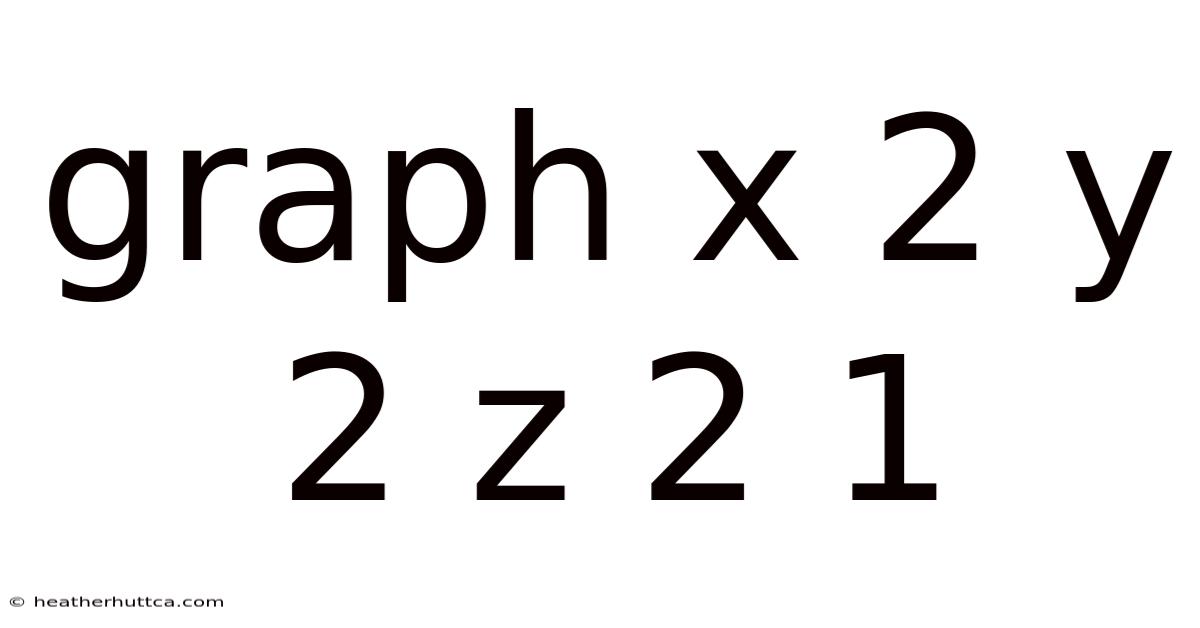
Understanding the Graph of x² + y² + z² = 1: The Unit Sphere in 3D Space
The equation x² + y² + z² = 1 represents one of the most fundamental shapes in three-dimensional geometry: the unit sphere. Here's the thing — this equation describes all points in 3D space that are exactly one unit away from the origin (0, 0, 0), forming a perfectly symmetrical sphere with radius 1. Understanding this equation is crucial for students and professionals in mathematics, physics, engineering, and computer graphics, as it serves as the foundation for spherical coordinates, vector analysis, and spatial modeling Less friction, more output..
Mathematical Explanation of the Equation
The equation x² + y² + z² = 1 is derived from the three-dimensional distance formula. In 2D, the distance between two points (x, y) and the origin (0, 0) is √(x² + y²). Consider this: extending this to 3D, the distance from any point (x, y, z) to the origin is √(x² + y² + z²). When this distance equals 1, squaring both sides gives us x² + y² + z² = 1 Simple, but easy to overlook. Simple as that..
This equation defines a surface where every point on the sphere satisfies the condition that the sum of the squares of its coordinates equals 1. The variables x, y, and z represent coordinates in three-dimensional space, and the squaring ensures that all points are equidistant from the center, regardless of their direction.
Graphing the Unit Sphere
Visualizing the unit sphere requires understanding its symmetry and key features:
- Cross-sections: Cutting the sphere with coordinate planes reveals circular cross-sections. Here's one way to look at it: setting z = 0 gives x² + y² = 1, which is a unit circle in the xy-plane.
- Octant symmetry: The sphere is symmetric across all eight octants, meaning it appears identical in every direction from the origin.
- Axis intercepts: The sphere intersects the x, y, and z-axes at (±1, 0, 0), (0, ±1, 0), and (0, 0, ±1), respectively.
To graph this equation manually, you would plot points where x, y, and z values satisfy the equation. To give you an idea, (1, 0, 0), (0, 1, 0), and (0, 0, 1) are all valid points on the sphere, as are (√2/2, √2/2, 0) and (√3/3, √3/3, √3/3).
Key Properties of the Unit Sphere
The unit sphere has several important mathematical properties:
- Surface area: The total surface area is 4π square units, which is approximately 12.57 square units.
- Volume: The volume enclosed by the sphere is (4/3)π cubic units, approximately 4.19 cubic units.
- Symmetry: The sphere is invariant under rotations about the origin, making it a key object in group theory and physics.
- Great circles: Any plane passing through the origin intersects the sphere in a great circle, such as the equator on Earth.
These properties make the unit sphere essential in fields like spherical harmonics, quantum mechanics, and navigation systems.
Applications in Real-World Contexts
The unit sphere has numerous practical applications:
- Physics: In electromagnetism, electric and magnetic fields are often analyzed using spherical coordinates centered at the origin. The unit sphere helps model radiation patterns and wave propagation.
- Computer graphics: 3D rendering engines use unit spheres to calculate lighting, reflections, and shading effects. Normal vectors on a unit sphere are critical for realistic image generation.
- Engineering: Structural engineers model stress and strain distributions in spherical objects using unit sphere coordinates. In robotics, joint movements are often described using spherical parameters.
- Data science: Machine learning algorithms, particularly those involving directional data or unit vectors, rely on the properties of the unit sphere for normalization and clustering.
Parametric Representation
While the Cartesian equation x² + y² + z² = 1 is standard, the sphere can also be represented parametrically using spherical coordinates:
- x = sinθ cosφ
- y = sinθ sinφ
- z = cosθ
where θ (polar angle) ranges from 0 to π, and φ (azimuthal angle) ranges from 0 to 2π. This representation is particularly useful in calculus for integrating over spherical surfaces.
Frequently Asked Questions (FAQ)
Q: Why is it called a "unit" sphere?
A: The term "unit" refers to the radius of 1, meaning every point on the sphere is exactly one unit away
from the origin.
Q: Can I have a sphere with a different radius? A: Absolutely! To represent a sphere with radius 'r', simply replace '1' in the equation x² + y² + z² = 1 with 'r²'. So, the equation becomes x² + y² + z² = r². The parametric representation also adjusts accordingly: x = r sinθ cosφ, y = r sinθ sinφ, and z = r cosθ That alone is useful..
Q: What's the difference between a sphere and a unit sphere? A: A sphere is a three-dimensional object defined by a set of points equidistant from a central point. A unit sphere is a specific sphere with a radius of one unit. It's a standardized reference point for many mathematical and computational applications That's the part that actually makes a difference..
Q: How do I find the tangent plane to the unit sphere at a given point? A: The equation of the tangent plane to the unit sphere at a point (x₀, y₀, z₀) on the sphere is given by x₀x + y₀y + z₀z = 1. This is derived from the gradient of the function f(x, y, z) = x² + y² + z² - 1, which is ∇f = <2x, 2y, 2z>. At the point (x₀, y₀, z₀), the gradient is <2x₀, 2y₀, 2z₀>, and the equation of the tangent plane is formed by taking the dot product with (x - x₀, y - y₀, z - z₀) and setting it equal to zero.
Beyond the Basics: Advanced Considerations
The unit sphere's simplicity belies its depth. Considerations beyond the introductory level include:
- Stereographic Projection: This mapping projects points on the sphere onto a plane, preserving angles locally. It's a powerful tool in complex analysis and differential geometry.
- Riemannian Geometry: The unit sphere is a prime example of a manifold, and its geometry is studied extensively in Riemannian geometry. The metric on the sphere is different from Euclidean space, leading to unique properties.
- Discrete Representations: In computational settings, the unit sphere is often approximated by a discrete set of points, such as a mesh of triangles. This is crucial for rendering and simulations.
- Higher-Dimensional Spheres: The concept of a sphere extends to higher dimensions. A hypersphere in n-dimensional space is defined by the equation x₁² + x₂² + ... + xₙ² = 1. These higher-dimensional spheres have fascinating properties and applications in areas like string theory.
All in all, the unit sphere, seemingly a simple geometric shape, is a cornerstone of mathematics, physics, and engineering. Its elegant equation, fundamental properties, and versatile applications make it an indispensable tool for understanding and modeling the world around us. From describing the curvature of the Earth to representing complex data patterns, the unit sphere continues to inspire and enable innovation across a wide range of disciplines. Its enduring relevance highlights the power of fundamental mathematical concepts to access profound insights and drive technological advancements.
Beyond the Basics: Advanced Considerations
The unit sphere’s simplicity belies its depth. Considerations beyond the introductory level include:
- Stereographic Projection: This mapping projects points on the sphere onto a plane, preserving angles locally. It’s a powerful tool in complex analysis and differential geometry.
- Riemannian Geometry: The unit sphere is a prime example of a manifold, and its geometry is studied extensively in Riemannian geometry. The metric on the sphere is different from Euclidean space, leading to unique properties.
- Discrete Representations: In computational settings, the unit sphere is often approximated by a discrete set of points, such as a mesh of triangles. This is crucial for rendering and simulations.
- Higher-Dimensional Spheres: The concept of a sphere extends to higher dimensions. A hypersphere in n-dimensional space is defined by the equation x₁² + x₂² + ... + xₙ² = 1. These higher-dimensional spheres have fascinating properties and applications in areas like string theory.
On top of that, the unit sphere plays a significant role in probability and statistics. The concept of a unit sphere in a high-dimensional space is central to Principal Component Analysis (PCA), a technique used for dimensionality reduction and feature extraction. The eigenvectors of the covariance matrix of a dataset represent the principal components, and the unit sphere is the space in which these components are projected, allowing for visualization and interpretation of the data’s variance. The spherical harmonics, a set of orthogonal functions, are also intimately linked to the unit sphere and are extensively used in areas like signal processing and quantum mechanics to describe rotational symmetry That alone is useful..
Another intriguing area is the study of spherical trigonometry, which extends the familiar rules of Euclidean trigonometry to spherical geometry. On the flip side, this is essential for solving problems involving distances and angles on the surface of a sphere, such as navigation and celestial mechanics. The spherical law of cosines, for instance, provides a crucial relationship for calculating distances between points on a sphere, taking into account the curvature of the surface Which is the point..
Finally, the unit sphere’s properties are leveraged in areas like image processing. Spherical harmonics are used to represent and analyze images, particularly in applications like medical imaging and satellite imagery, offering a compact and efficient way to capture the spatial relationships within the data Surprisingly effective..
At the end of the day, the unit sphere, seemingly a simple geometric shape, is a cornerstone of mathematics, physics, and engineering. That's why from describing the curvature of the Earth to representing complex data patterns, the unit sphere continues to inspire and enable innovation across a wide range of disciplines. In real terms, its elegant equation, fundamental properties, and versatile applications make it an indispensable tool for understanding and modeling the world around us. Its enduring relevance highlights the power of fundamental mathematical concepts to open up profound insights and drive technological advancements.
