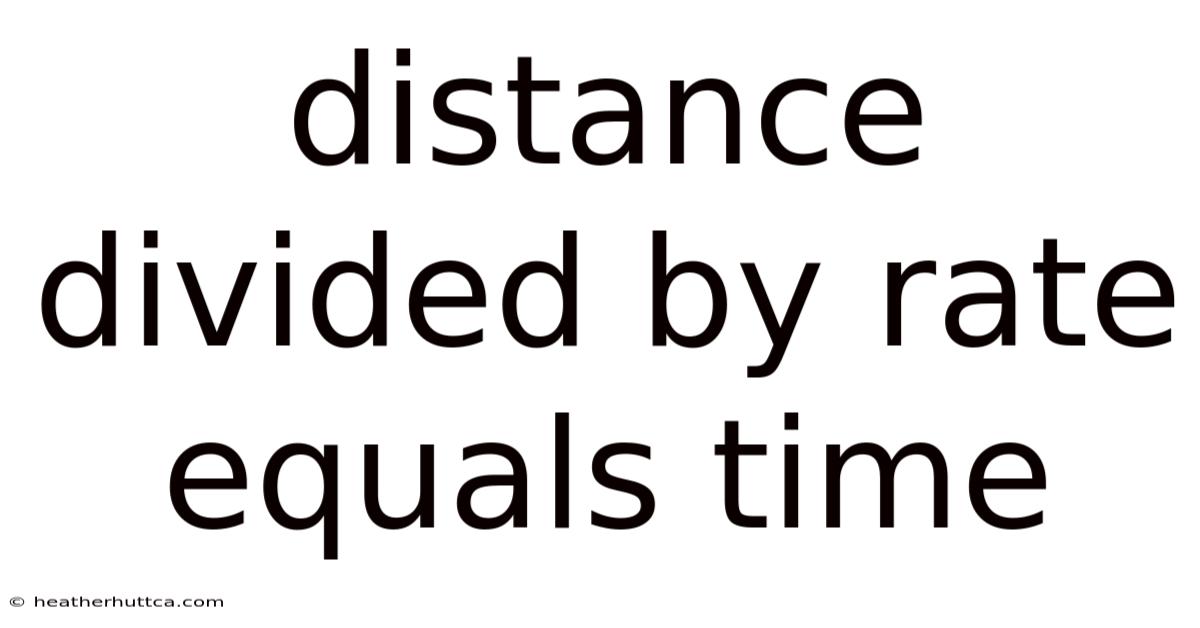
Understanding the Formula: Distance Divided by Rate Equals Time
The relationship between distance, rate, and time is one of the most fundamental concepts in mathematics and physics. The formula time = distance ÷ rate allows us to calculate how long it takes to travel a certain distance at a given speed. Even so, whether you’re planning a road trip, analyzing athletic performance, or solving physics problems, this equation is a cornerstone of problem-solving. In this article, we’ll explore the components of the formula, how to apply it in real-world scenarios, and the scientific principles that underpin it Turns out it matters..
What Does Distance Divided by Rate Equal Time Mean?
The formula time = distance ÷ rate is derived from the basic relationship between three variables:
- Distance (d): The total length of the path traveled, measured in units like miles, kilometers, or meters.
- Rate (r): The speed at which an object moves, typically expressed in units like miles per hour (mph) or kilometers per hour (km/h).
- Time (t): The duration of the journey, measured in hours, minutes, or seconds.
This formula is a rearrangement of the more familiar equation distance = rate × time (d = r × t). By isolating time, we can solve for how long a trip will take if we know the distance and speed. Here's one way to look at it: if you drive 120 miles at a constant speed of 60 mph, the time required is 120 ÷ 60 = 2 hours Easy to understand, harder to ignore. Simple as that..
Step-by-Step Guide to Using the Formula
To apply the formula effectively, follow these steps:
-
- Still, 2. And Plug values into the formula: Use time = distance ÷ rate. , miles to kilometers or hours to minutes).
Identify the known values: Determine the distance and rate provided in the problem.
Ensure consistent units: Convert units if necessary (e.Worth adding: g. 4. Calculate and interpret the result: Ensure the answer makes sense in the context of the problem.
- Still, 2. And Plug values into the formula: Use time = distance ÷ rate. , miles to kilometers or hours to minutes).
Example Problem:
A cyclist travels 30 kilometers at a speed of 15 km/h. How long does the journey take?
- Solution: Time = 30 km ÷ 15 km/h = 2 hours.
This straightforward method works for any scenario where rate and distance are constant That's the whole idea..
Scientific Explanation: Why Does This Formula Work?
The formula time = distance ÷ rate is rooted in the physics of motion. In kinematics, rate (or speed) is defined as the rate of change of distance with respect to time. Mathematically, this is expressed as:
Rate = Distance ÷ Time
Rearranging this equation gives us the formula for time Which is the point..
It’s important to note that this formula assumes constant rate, meaning the speed doesn’t change during the journey. In real-world situations, factors like acceleration, traffic, or terrain can affect speed, but the formula still provides a useful approximation when averaged over time Small thing, real impact..
The formula also aligns with the International System of Units (SI), where distance is measured in meters, rate in meters per second, and time in seconds. Still, in everyday applications, units like kilometers and hours are more practical Simple, but easy to overlook..
Common Mistakes and Frequently Asked Questions
1. Mixing Up the Formula:
A frequent error is confusing time = distance ÷ rate with distance = rate × time. Always double-check which variable you’re solving for.
2. Unit Conversion Errors:
If distance is in miles and rate is in km/h, convert them to the same unit system before calculating. Here's one way to look at it: 60 mph ≈ 96.56 km/h.
3. Non-Constant Rates:
If speed varies, use the average rate over the journey. Here's a good example: if you drive half the distance
4. Ignoring the Direction of Travel
When dealing with vector quantities such as velocity (which includes direction), the simple scalar formula time = distance ÷ rate only gives you the magnitude of the elapsed time. If you need to know how long it takes to travel against a current or up a slope, you must first adjust the rate to reflect those conditions (e.g., subtract the current’s speed from your boat’s speed, or add the grade‑induced slowdown to your cycling speed) That's the whole idea..
Advanced Applications
A. Variable Speed Situations
When speed isn’t constant, you can still use the same underlying principle—integrating distance over time. The general relationship is
[ \text{distance} = \int_{0}^{T} v(t),dt, ]
where (v(t)) is the instantaneous speed at time (t) and (T) is the total travel time. Solving for (T) generally requires algebraic manipulation or numerical methods (e.g., the trapezoidal rule).
Example: A car accelerates uniformly from rest to 20 m/s over 10 s, then cruises at that speed for another 30 s.
- Distance during acceleration: ( \tfrac{1}{2} a t^{2} = \tfrac{1}{2}(2,\text{m/s}^2)(10,\text{s})^{2}=100,\text{m}).
- Distance during cruising: (20,\text{m/s} \times 30,\text{s}=600,\text{m}).
- Total distance = 700 m, total time = 40 s.
If you only know the total distance (700 m) and the average speed (17.5 m/s), you can still retrieve the total time with the familiar formula:
[ T = \frac{700\ \text{m}}{17.5\ \text{m/s}} = 40\ \text{s}. ]
B. Real‑World Scenarios: Traffic and Public Transit
Public‑transport schedules often list “average speed” as a convenient way to estimate travel time. Even so, dwell times at stops, boarding delays, and traffic signals introduce non‑travel intervals. To obtain a realistic estimate:
[ \text{Total Time} = \frac{\text{Travel Distance}}{\text{Average Travel Speed}} + \text{Total Dwell Time}. ]
If a bus covers 15 km at an average travel speed of 30 km/h and makes 5 stops, each lasting roughly 30 seconds, the calculation becomes:
[ \frac{15\ \text{km}}{30\ \text{km/h}} = 0.5\ \text{h} = 30\ \text{min}, ] [ \text{Dwell Time} = 5 \times 0.5\ \text{min} = 2.Practically speaking, 5\ \text{min}, ] [ \text{Total Time} \approx 32. 5\ \text{min}.
C. Using the Formula in Programming
When building a simple travel‑time calculator, the algorithm is essentially three lines of code:
def travel_time(distance, speed):
    if speed <= 0:
        raise ValueError("Speed must be greater than zero.")
    return distance / speed   # returns time in the same unit as distance/speed
The function can be expanded to accept units, perform conversion, and even incorporate a list of speed changes (e.g., for a route with varying speed limits).
Practice Problems (With Solutions)
| # | Problem | Solution Sketch |
|---|---|---|
| 1 | A runner completes a 10‑km race in 50 minutes. What was the average speed in km/h? But | Convert 50 min → 0. Here's the thing — 833 h → (10\text{ km} ÷ 0. Plus, 833\text{ h} ≈ 12. 0\text{ km/h}). |
| 2 | A train travels 180 mi at 45 mph. Day to day, how long does the trip take? | (180 ÷ 45 = 4) h. And |
| 3 | A hiker walks 8 km at 4 km/h up a hill, then 8 km at 5 km/h downhill. Total time? Worth adding: | (8 ÷ 4 = 2) h + (8 ÷ 5 = 1. 6) h = 3.6 h (3 h 36 min). |
| 4 | A delivery van averages 30 km/h but stops for a total of 15 min during a 90‑km route. Total elapsed time? On the flip side, | Travel time = (90 ÷ 30 = 3) h. Add stop time = 0.Practically speaking, 25 h → 3. Day to day, 25 h (3 h 15 min). |
| 5 | A cyclist’s speed varies linearly from 10 km/h to 20 km/h over a 30‑km ride. Approximate travel time using average speed. | Average speed = ((10+20)/2 = 15) km/h → (30 ÷ 15 = 2) h. |
Quick Reference Cheat Sheet
| Quantity | Symbol | Typical Units | Formula |
|---|---|---|---|
| Distance | (d) | km, mi, m | (d = r \times t) |
| Rate / Speed | (r) | km/h, mph, m/s | (r = d ÷ t) |
| Time | (t) | h, min, s | (t = d ÷ r) |
| Average Speed (varying rate) | (\bar{r}) | same as (r) | (\bar{r} = \dfrac{\text{total distance}}{\text{total time}}) |
| Total Travel Time (including stops) | (t_{\text{total}}) | h, min | (t_{\text{total}} = \dfrac{d}{\bar{r}} + t_{\text{stops}}) |
Conclusion
The relationship time = distance ÷ rate is one of the most universally applicable tools in everyday mathematics and physics. By mastering the simple steps of identifying known quantities, keeping units consistent, and performing a straightforward division, you can solve a vast array of practical problems—from planning a road trip to estimating how long a marathon will take But it adds up..
When conditions become more complex—variable speeds, stops, or directional factors—the same core principle still applies; you just need to incorporate averages, integrals, or additional terms to capture the nuances of real‑world motion.
Remember: the formula works best when the rate is constant, but with a little extra thinking you can adapt it to almost any scenario. On top of that, keep this cheat sheet handy, practice with the sample problems, and you’ll find that calculating travel time becomes second nature. Safe travels, and happy calculating!
You'll probably want to bookmark this section That's the part that actually makes a difference..
Over uneven terrain or congested corridors, break the route into constant‑rate legs, sum the individual times, and treat any pauses as additive offsets rather than hidden variables. This modular approach preserves accuracy while letting you update estimates on the fly as conditions evolve It's one of those things that adds up. Nothing fancy..
When rates change smoothly rather than in steps, replace piecewise arithmetic with an integral: total time equals the integral of the reciprocal of speed with respect to distance, or equivalently the time integral of speed over elapsed time. For common profiles—linear acceleration, exponential decay, or sinusoidal variation—closed‑form expressions collapse back to simple averages, confirming that the core division remains the engine beneath the detail.
In vector settings, distinguish speed from velocity: speed governs the clock, while displacement may be shorter than path length. That said, if you need arrival time, use total path length and speed; if you need average velocity for direction‑dependent outcomes, use net displacement over total time. This subtle shift prevents sign errors and clarifies why a round trip can have zero average velocity yet a positive average speed.
You'll probably want to bookmark this section.
Finally, propagate uncertainties by treating time as a function of distance and rate and applying first‑order error combinations: fractional uncertainty in time is roughly the sum of fractional uncertainties in distance and rate. This lets you state confidence intervals for schedules without rerunning full calculations Simple, but easy to overlook..
Conclusion
The relationship time = distance ÷ rate is one of the most universally applicable tools in everyday mathematics and physics. By mastering the simple steps of identifying known quantities, keeping units consistent, and performing a straightforward division, you can solve a vast array of practical problems—from planning a road trip to estimating how long a marathon will take.
When conditions become more complex—variable speeds, stops, or directional factors—the same core principle still applies; you just need to incorporate averages, integrals, or additional terms to capture the nuances of real‑world motion That's the part that actually makes a difference..
Remember: the formula works best when the rate is constant, but with a little extra thinking you can adapt it to almost any scenario. Day to day, keep this cheat sheet handy, practice with the sample problems, and you’ll find that calculating travel time becomes second nature. Safe travels, and happy calculating!
Building upon these principles, one must prioritize clarity in communication and meticulous attention to detail. In real terms, such diligence ensures clarity amid complexity. In essence, adaptability coupled with precision defines effective problem-solving.
The interplay of simplicity and nuance underscores the enduring relevance of foundational knowledge. Thus, mastery emerges not merely through mastery, but through mindful application Not complicated — just consistent..
