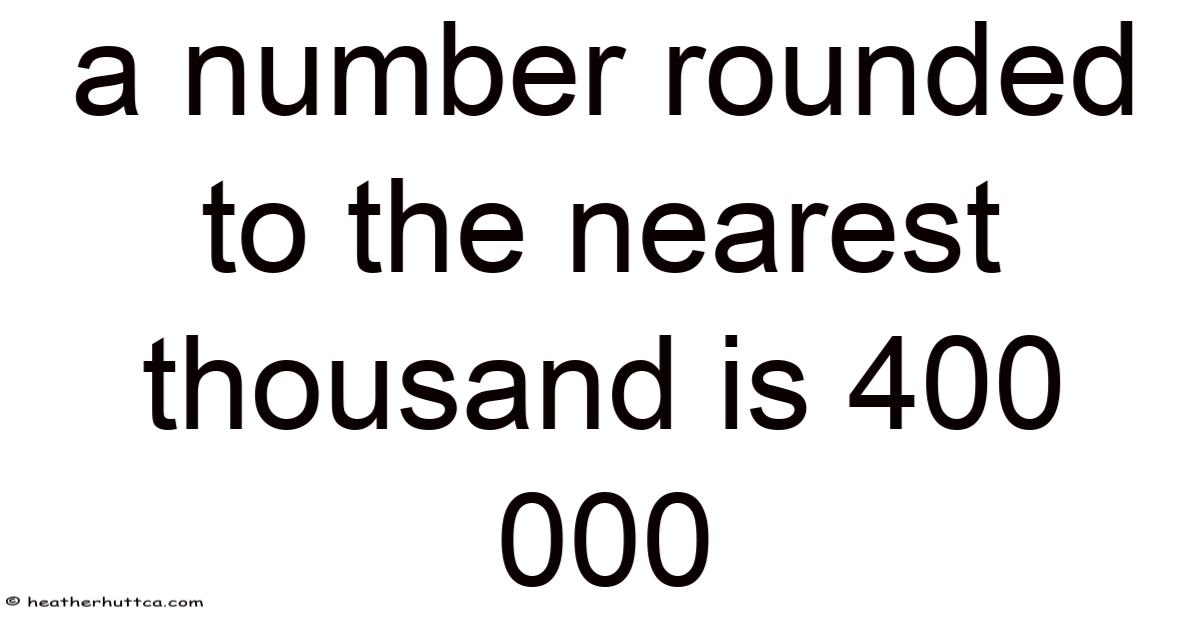
Understanding Rounding to the Nearest Thousand: A complete walkthrough
When dealing with large numbers, rounding is a fundamental skill that simplifies calculations and enhances clarity in communication. One common rounding scenario involves approximating a number to the nearest thousand. That said, for instance, the statement “a number rounded to the nearest thousand is 400,000” highlights how rounding transforms precise values into more manageable figures. This article explores the mechanics of rounding, its applications, and the nuances of interpreting rounded results, using 400,000 as a focal point Not complicated — just consistent..
What Does It Mean to Round to the Nearest Thousand?
Rounding to the nearest thousand involves adjusting a number so that it reflects the closest multiple of 1,000. On the flip side, this process simplifies complex numbers while retaining a reasonable level of accuracy. Also, for example, if a number rounds to 400,000, it means the original value was closer to 400,000 than to 399,000 or 401,000. Day to day, the rounding rule is straightforward: examine the digit in the hundreds place (the third digit from the right). If this digit is 5 or greater, round up; if it is 4 or less, round down The details matter here..
The Rounding Process: Step-by-Step
To determine whether a number rounds to 400,000, follow these steps:
- Identify the Hundreds Place: Look at the third digit from the right. Here's one way to look at it: in 398,765, the hundreds digit is 8.
- Apply the Rounding Rule:
- If the hundreds digit is 5–9, round the thousands digit up by 1.
- If the hundreds digit is 0–4, keep the thousands digit unchanged.
- Adjust the Number: Replace all digits to the right of the thousands place with zeros.
Example 1:
- Number: 398,765
- Hundreds digit: 8 (≥5) → Round up.
- Rounded result: 400,000.
Example 2:
- Number: 401,234
- Hundreds digit: 2 (<5) → Round down.
- Rounded result: 400,000.
Example 3:
- Number: 399,500
- Hundreds digit: 5 (≥5) → Round up.
- Rounded result: 400,000.
Range of Numbers That Round to 400,000
A number rounds to 400,000 if it lies within the range 399,500 to 400,499 (inclusive). Here’s why:
- Lower Bound (399,500): The hundreds digit is 5, so rounding up increases the thousands digit from 399 to 400.
- Upper Bound (400,499): The hundreds digit is 4, so rounding down keeps the thousands digit at 400.
Any number outside this range will round to a different multiple of 1,000. For instance:
- 399,499 rounds to 399,000 (hundreds digit = 4).
- 400,500 rounds to 401,000 (hundreds digit = 5).
Applications of Rounding in Real Life
Rounding to the nearest thousand is widely used in fields requiring simplified data representation:
-
Finance:
- Companies report revenues or expenses in rounded figures (e.g., “$400 million”) for annual reports.
- Example: A company earning $399,800 might round to 400,000 to make clear scale.
-
Demographics:
- Population statistics are often rounded for readability. A city with 399,700 residents might be described as having 400,000 people.
-
Education:
- Teachers use rounding to teach place value and estimation. Students learn to approximate values like 398,250 as 400,000.
-
Engineering and Science:
- Measurements are rounded to match instrument precision. A sensor reading 399,600 units might be reported as 400,000.
Common Misconceptions About Rounding
-
“Rounding Always Reduces Precision”:
While rounding simplifies numbers, it doesn’t inherently lose value. As an example, rounding 399,500 to 400,000 retains accuracy within a ±500 margin Worth knowing.. -
“All Numbers in the 400,000 Range Are Equally Likely”:
The distribution of numbers depends on context. In financial data, values might cluster near specific points, affecting rounding outcomes Which is the point.. -
“Rounding Is Always Exact”:
Rounded numbers are approximations. Take this case: 399,500 and 400,499 both round to 400,000, but their original values differ by nearly 1,000 But it adds up..
Why 400,000 Is a Common Rounded Value
The number 400,000 is a round figure that simplifies communication. Its use reflects a balance between precision and practicality:
- Ease of Comprehension: Large numbers like 399,876 are cumbersome, while 400,000 is instantly recognizable. Consider this: - Standardization: Industries often adopt rounded figures for consistency (e. That said, g. , tax brackets, population censuses).
- Visual Clarity: In graphs or charts, rounded values reduce clutter and improve readability.
Conclusion
Rounding to the nearest thousand is a vital mathematical tool that transforms complex numbers into digestible approximations. That's why when a number rounds to 400,000, it signifies that the original value fell within a specific range (399,500–400,499). This process is indispensable in finance, demographics, education, and science, where clarity and efficiency outweigh the need for exactness. By mastering rounding rules and understanding their implications, individuals can work through numerical data with confidence, ensuring accuracy without sacrificing simplicity.
Practical Tips for Accurate Rounding
| Situation | Recommended Approach | Example |
|---|---|---|
| Reporting financial results | Round to the nearest thousand only after the final audit. | $399,740 → $400,000 |
| Presenting survey data | Use the nearest hundred for small samples; thousand for large samples. | 3,245 respondents → 3,200 |
| Scientific measurements | Match the rounding to the instrument’s resolution. In practice, 6 °C (resolution 0. | A thermometer reads 399.1 °C) → 400 °C |
| Teaching estimation | Encourage “round then add” strategies before applying formal rules. |
1. Keep the Rounding Context in Mind
Rounding is not a one‑size‑fits‑all operation. The acceptable level of precision depends on the audience and the purpose. In a board meeting, a figure of 400,000 may be sufficient, whereas a technical report might demand the exact value of 399,876.
2. Use Rounding Consistently Within a Dataset
When a dataset contains multiple values that will be rounded, apply the same rule across the board. Mixing rounding to the nearest thousand with rounding to the nearest hundred can distort comparisons and lead to misinterpretation Most people skip this — try not to..
3. Document the Rounding Method
In any formal analysis or report, state the rounding rule used (e.g., “All monetary figures rounded to the nearest thousand dollars”). This transparency allows readers to assess the potential impact of the approximation.
When Rounding Can Mislead
| Scenario | Risk | Mitigation |
|---|---|---|
| Aggregating rounded numbers | Summing rounded figures can over‑ or under‑estimate by up to the rounding error multiplied by the count. | Keep a running total of the unrounded values and round the final sum. |
| Comparing datasets with different rounding rules | Apparent discrepancies may be artifacts of rounding rather than real differences. Practically speaking, | Align the rounding rules before comparison or use the raw data. |
| Reporting on small populations | Rounding a small number like 398 to 400 can obscure meaningful variations. Now, | Use exact figures or a lower rounding threshold (e. g., nearest ten). |
The official docs gloss over this. That's a mistake.
Final Thoughts
Rounding to the nearest thousand—and to 400,000 in particular—serves as a bridge between raw data and human comprehension. By simplifying numbers, we create mental shortcuts that enable faster decision‑making, clearer communication, and more effective visual storytelling. Yet, the power of rounding comes with responsibility: choose the level of precision that matches the stakes, maintain consistency, and always disclose your methodology.
When you see a figure like 400,000, remember it is not merely a random round number; it is the result of a deliberate choice to balance detail with clarity. Mastering this balance is a mark of numerical literacy—an essential skill in our data‑driven world Small thing, real impact..
