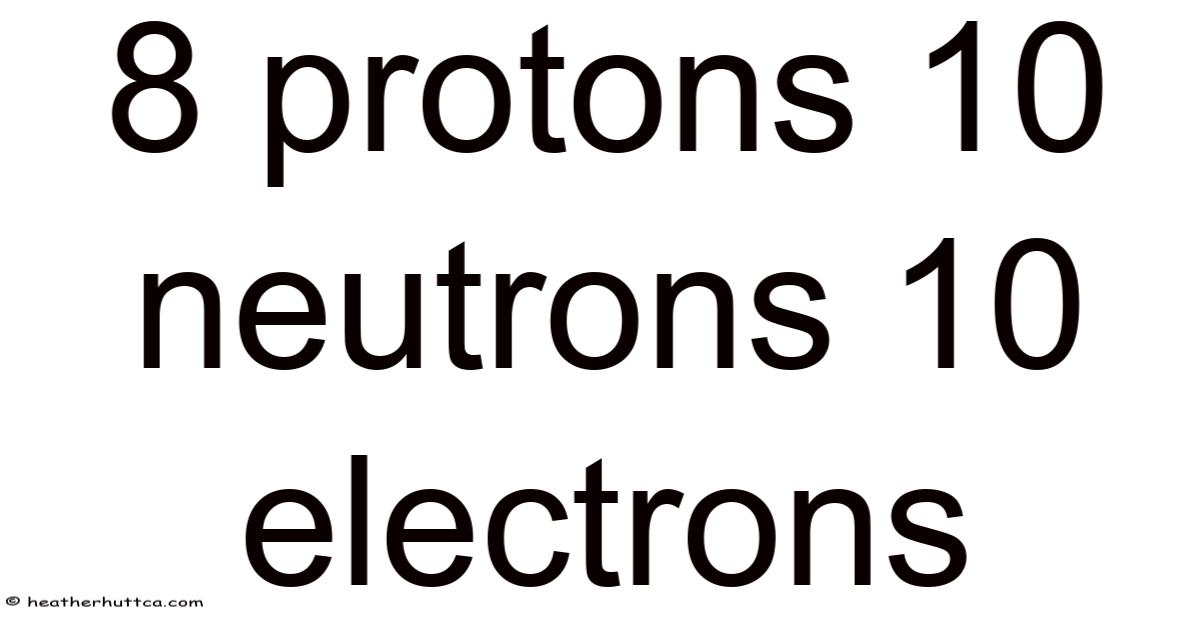
O‑18⁻²: Understanding an Oxygen Isotope with Two Extra Electrons
Oxygen is the third‑most abundant element in the universe and a cornerstone of life on Earth. When this nucleus captures two additional electrons, it becomes the O‑18²⁻ ion, a doubly‑charged anion with unique physical and chemical behavior. Still, while most people are familiar with the common ^16O isotope, the less‑abundant ^18O isotope—characterized by 8 protons, 10 neutrons, and typically 8 electrons—is key here in fields ranging from climate science to medicine. This article explores the structure, stability, and applications of an atom (or ion) that possesses 8 protons, 10 neutrons, and 10 electrons, providing a full breakdown for students, researchers, and curious readers alike That alone is useful..
1. Basic Nuclear Structure: 8 p + 10 n = ^18O
1.1 Proton Count Determines the Element
The number of protons—also called the atomic number (Z)—defines the chemical element. With 8 protons, the nucleus is unequivocally oxygen. All isotopes of oxygen share this proton count, but they differ in neutron number.
1.2 Neutron Count Defines the Isotope
Neutrons (N) contribute to the atomic mass but not to the chemical identity. 10 neutrons give a mass number of A = Z + N = 8 + 10 = 18, labeling the nucleus as ^18O. Compared with the dominant ^16O (8 p + 8 n), ^18O is 2 atomic mass units heavier.
1.3 Natural Abundance and Origin
^18O accounts for roughly 0.2 % of natural oxygen. It is produced in stellar nucleosynthesis during the helium‑burning phase and is incorporated into water molecules, carbonates, and organic compounds on Earth. Its slight enrichment or depletion in geological samples serves as a powerful proxy for past temperature and precipitation patterns Not complicated — just consistent. Worth knowing..
2. From Neutral Atom to O‑18²⁻ Ion: Adding Two Electrons
2.1 Electron Configuration of Neutral ^18O
A neutral oxygen atom (8 p + 8 e) follows the electron configuration 1s² 2s² 2p⁴. The outer 2p subshell holds four electrons, leaving two spots unfilled and giving oxygen its high electronegativity and tendency to attract electrons Worth knowing..
2.2 Formation of the Doubly Charged Anion
When two extra electrons are added, the total electron count becomes 10, resulting in the O‑18²⁻ ion. The new configuration is 1s² 2s² 2p⁶, which mirrors the noble‑gas configuration of neon. This explains why the O²⁻ ion is electrostatically stable—its valence shell is completely filled.
2.3 Charge Balance in Compounds
In most chemical environments, O²⁻ does not appear alone; it is paired with cations (e.g., Na⁺, Ca²⁺) to form ionic compounds such as Na₂O, CaO, or complex minerals like silicates. The presence of the heavier ^18O isotope does not significantly alter the ionic radius, but it does affect vibrational frequencies in the crystal lattice, a factor exploited in spectroscopic studies.
3. Physical Properties of the O‑18²⁻ Ion
| Property | Typical Value (for O²⁻) | Effect of ^18O Isotope |
|---|---|---|
| Atomic Mass | 16 u (for ^16O) | Increases to 17.999 u (≈ 12 % heavier) |
| Ionic Radius | ~140 pm (Shannon) | Negligible change; mass does not affect radius |
| Electronegativity | 3.44 (Pauling) | Unchanged; isotope effect is electronic, not nuclear |
| Vibrational Frequency (O–H stretch) | ~3650 cm⁻¹ (H₂O) | Shifts to ~3610 cm⁻¹ in H₂^18O (≈ 1 % lower) |
Most guides skip this. Don't.
The most noticeable impact of the extra neutrons is on vibrational spectroscopy. Heavier isotopes vibrate more slowly, causing measurable shifts in infrared (IR) and Raman spectra. These shifts enable scientists to trace isotopic composition in water, carbonates, and organic molecules.
4. Chemical Behavior and Reactivity
4.1 Basicity and Oxidation State
O²⁻ is the most reduced form of oxygen (oxidation state –2). It readily donates its extra electrons in redox reactions, acting as a strong reducing agent under extreme conditions (e.g., high‑temperature metallurgical processes). Still, in everyday aqueous chemistry, O²⁻ is largely spectator, forming stable salts That alone is useful..
4.2 Solubility and Hydrolysis
In water, O²⁻ quickly hydrolyzes:
[ \text{O}^{2-} + \text{H}_2\text{O} \rightarrow \text{HO}^{-} + \text{OH}^{-} ]
The reaction produces hydroxide ions, making solutions strongly basic (pH > 12). The presence of ^18O does not alter the equilibrium constant but can be monitored via isotopic labeling of the resulting hydroxide Took long enough..
4.3 Participation in Biological Systems
While free O²⁻ ions are rare in biology, ^18O‑labeled water (H₂^18O) is widely used to trace metabolic pathways, measure water turnover, and study enzyme mechanisms. The doubly‑charged ion itself is not biologically active, but its incorporation into phosphate groups (e.g., ^18O‑labeled ATP) provides a powerful tool for kinetic isotope effect (KIE) experiments It's one of those things that adds up..
5. Applications of the ^18O²⁻ Isotope
5.1 Paleoclimatology
The ratio ^18O/^16O in marine carbonates records ancient temperatures. Higher ^18O enrichment indicates colder periods because lighter ^16O preferentially evaporates. Scientists extract the carbonate, convert the oxygen to CO₂, and analyze the isotopic composition with mass spectrometry. The underlying O²⁻ ions in the crystal lattice retain the isotopic signature Simple as that..
5.2 Medical Diagnostics
^18O‑labeled water is a safe, non‑radioactive tracer used in:
- Total body water measurement: By ingesting a known amount of H₂^18O and later analyzing urine or blood, clinicians calculate fluid compartments.
- Gastrointestinal transit studies: Breath tests detect ^18O in exhaled CO₂ after ingestion of ^18O‑labeled substrates, revealing malabsorption or bacterial overgrowth.
5.3 Materials Science
Isotopically enriched silicon dioxide (Si^18O₂) exhibits altered thermal conductivity and phonon dispersion. Researchers fabricate thin films with ^18O to investigate heat transport at the nanoscale, which is valuable for semiconductor cooling technologies.
5.4 Stable Isotope Labeling in Chemistry
In organic synthesis, incorporating ^18O into carbonyl groups (e.g., ^18O‑labeled aldehydes) helps elucidate reaction mechanisms via ^18O‑NMR or mass spectrometry. The doubly‑charged anion is often a precursor, generated by reacting ^18O‑enriched water with strong bases.
6. Experimental Techniques for Detecting O‑18²⁻
6.1 Mass Spectrometry (MS)
Isotope‑ratio mass spectrometers separate ions based on mass‑to‑charge (m/z) ratios. The O²⁻ ion appears at m/z = 9 for ^16O (8 p + 2 e) and m/z = 9.5 for ^18O (10 p + 2 e). High‑resolution MS can distinguish these peaks, providing precise isotopic ratios down to parts per million (ppm).
6.2 Infrared (IR) and Raman Spectroscopy
The vibrational frequencies of O–H, O–O, and metal‑oxygen bonds shift when ^18O replaces ^16O. To give you an idea, the O–H stretch in water moves from 3650 cm⁻¹ to 3610 cm⁻¹. By measuring these shifts, scientists quantify the fraction of ^18O in a sample without destroying it.
6.3 Nuclear Magnetic Resonance (NMR)
Although ^18O has a low natural abundance and a quadrupolar nucleus (spin = 0), enriched samples enable ^18O NMR experiments that reveal local chemical environments, particularly in carbonyl and phosphate groups Simple, but easy to overlook..
7. Frequently Asked Questions
Q1: Why does oxygen need two extra electrons to become O²⁻?
Oxygen’s valence shell (2p) holds six electrons when neutral (2p⁴). Adding two electrons completes the 2p subshell (2p⁶), achieving a noble‑gas configuration that is energetically favorable Nothing fancy..
Q2: Is ^18O²⁻ more stable than ^16O²⁻?
Stability is governed by electronic configuration, not neutron count. Both isotopes share identical electron arrangements, so their chemical stability is essentially the same. The difference lies in mass‑dependent properties such as vibrational frequencies Not complicated — just consistent..
Q3: Can I purchase ^18O‑enriched O²⁻ salts?
Yes, chemical suppliers provide ^18O‑enriched sodium oxide (Na₂^18O) or ^18O‑enriched calcium oxide (Ca^18O). These are used in isotopic labeling experiments and must be handled under anhydrous conditions to avoid hydrolysis Which is the point..
Q4: How does the presence of ^18O affect the pH of a solution?
Isotopic substitution does not change the acid–base equilibrium constants appreciably. That's why, a solution of O²⁻ derived from ^18O behaves the same as one from ^16O in terms of pH.
Q5: What safety precautions are needed when working with O²⁻ ions?
O²⁻ is a strong base and reacts violently with water, producing heat and hydroxide ions. Use gloves, goggles, and a fume hood, and add the oxide slowly to water under stirring to control exothermicity Worth keeping that in mind. Which is the point..
8. Theoretical Perspective: Quantum Mechanics of a Heavy Oxygen Ion
From a quantum‑chemical standpoint, the electronic wavefunction of O²⁻ is described by a closed‑shell configuration (1s² 2s² 2p⁶). The added neutrons alter the nuclear mass, which influences the Born–Oppenheimer approximation by slightly modifying the reduced mass of the electron–nucleus system. So naturally, the vibrational zero‑point energy is lower for ^18O²⁻, a subtle effect that becomes measurable in high‑resolution spectroscopy and contributes to the kinetic isotope effect observed in chemical reactions involving oxygen transfer The details matter here..
9. Summary and Outlook
An atom (or ion) with 8 protons, 10 neutrons, and 10 electrons represents the doubly‑charged ^18O²⁻ ion, a heavy isotope of oxygen that has captured two extra electrons to achieve a noble‑gas electron configuration. While its chemical reactivity mirrors that of the more common ^16O²⁻, the additional neutrons impart distinct mass‑dependent properties that are exploited across diverse scientific disciplines:
- Climate reconstruction through ^18O/^16O ratios in ice cores and marine sediments.
- Medical diagnostics using ^18O‑labeled water for body‑water and gastric‑emptying studies.
- Materials engineering where isotopic enrichment tailors thermal conductivity.
- Mechanistic chemistry where ^18O serves as a tracer to map oxygen atom transfer pathways.
Understanding the interplay between nuclear composition (protons + neutrons) and electron count is essential for interpreting isotopic effects, designing experiments, and applying the knowledge to real‑world problems. As analytical techniques become ever more sensitive, the subtle signatures of the ^18O²⁻ ion will continue to illuminate the hidden stories of Earth’s past, the inner workings of living systems, and the frontiers of material innovation.
