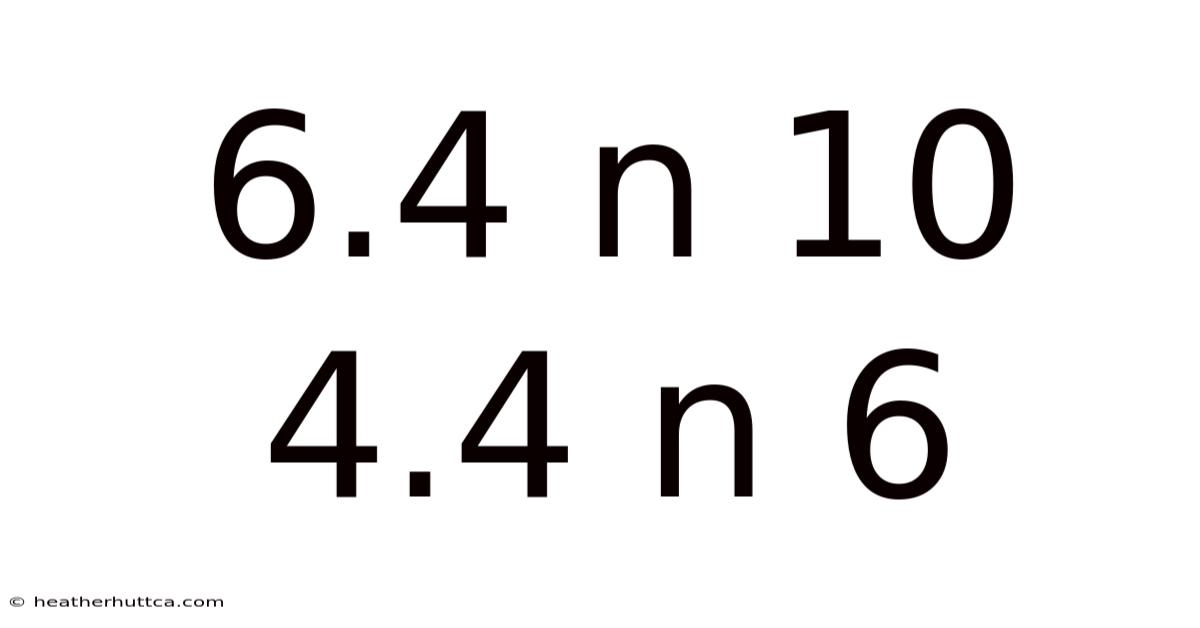
Scientific notation is one of the most practical mathematical tools available, designed to simplify the representation of extremely large or incredibly small values without sacrificing precision. Think about it: 4 n 10 4. Even so, 4 n 6**, you are looking at a compact, often handwritten or calculator-style shorthand for two separate numbers written in scientific notation. That said, when you encounter the expression **6. Understanding how to decode, convert, compare, and apply these values is essential for students, professionals, and anyone working with quantitative data. This guide breaks down exactly what this notation means, walks you through step-by-step conversions, explains comparison rules, and shows how these concepts apply across science, engineering, and everyday problem-solving Most people skip this — try not to..
What Does "6.4 n 10 4.4 n 6" Actually Mean?
At first glance, the sequence 6.4 n 10 4.Also, 4 n 6 may appear disjointed or like a formatting error. In reality, it represents two distinct values: 6.4 × 10^10 and 4.4 × 10^6. So the letter n is commonly used in educational materials, older calculators, and quick notes as a stand-in for "times ten raised to the power of. " When you see the pattern a n b, it directly translates to a × 10^b. That's why, 6.On the flip side, 4 n 10 becomes 6. In real terms, 4 multiplied by ten to the tenth power, while 4. 4 n 6 represents 4.4 multiplied by ten to the sixth power. Recognizing this shorthand eliminates confusion and allows you to approach the numbers with mathematical clarity.
Breaking Down Scientific Notation Step by Step
Scientific notation follows a highly structured format that prioritizes both readability and accuracy. Every properly formatted expression contains two core components that work together to communicate magnitude efficiently Which is the point..
The Role of the Coefficient
The first number in the expression, known as the coefficient or mantissa, must always fall within the range of 1 (inclusive) to 10 (exclusive). In our examples, 6.4 and 4.4 perfectly satisfy this requirement. The coefficient carries the significant digits of the original measurement, preserving precision while removing long strings of placeholder zeros. In laboratory reports, engineering schematics, and financial models, the coefficient often reflects the exact precision of the measuring instrument, making it a critical element for accurate data communication Practical, not theoretical..
Understanding the Exponent
The second component is the exponent, which dictates how many places the decimal point must shift. A positive exponent indicates a large number, requiring the decimal to move to the right. A negative exponent represents a value smaller than one, shifting the decimal to the left. In 6.4 n 10, the exponent is 10, meaning the decimal moves ten positions. In 4.4 n 6, the exponent is 6, requiring a six-place shift. This exponential scaling is what makes scientific notation indispensable for handling everything from galactic distances to atomic masses.
How to Convert These Numbers to Standard Form
Transforming scientific notation into standard decimal form is a straightforward process once you internalize decimal movement. Follow these clear steps to convert both expressions accurately:
- Identify the coefficient and locate its decimal point.
- Note the exponent value and determine the direction of movement (right for positive, left for negative).
- Shift the decimal point the exact number of places indicated, inserting zeros as placeholders when you run out of digits.
- Remove the exponential notation once the shift is complete.
Applying this method to 6.4 × 10^10 yields 64,000,000,000. Which means for 4. 4 × 10^6, the result is 4,400,000. In real terms, notice how the exponent controls the scale while the coefficient preserves the numerical identity. Practicing this conversion repeatedly builds automaticity and significantly reduces calculation errors in timed assessments or real-world applications.
Not the most exciting part, but easily the most useful That's the part that actually makes a difference..
Comparing Values in Scientific Notation
When determining which number is larger, many learners mistakenly focus solely on the coefficient. Still, the exponent always takes priority in scientific notation comparisons. Even though 6.4 is numerically greater than 4.4, the exponent 6 in 4.4 × 10^6 vastly outweighs a smaller exponent like 4 in 6.4 × 10^4 Still holds up..
Short version: it depends. Long version — keep reading Not complicated — just consistent..
- Check the exponents first. The number with the higher exponent is automatically larger, regardless of the coefficient.
- If exponents match, compare coefficients. The larger coefficient determines the greater value.
- Convert to standard form for verification. Writing out the full numbers provides visual confirmation when uncertainty arises.
Using this logical framework, 4.4 × 10^6 (4,400,000) is significantly larger than 6.4 × 10^4 (64,000). This principle applies universally, whether you are analyzing population growth, chemical concentrations, or computational processing speeds.
Real-World Applications of Scientific Notation
Scientific notation extends far beyond classroom exercises. It appears constantly in professional environments and everyday quantitative reasoning:
- Astronomy & Space Science: Interplanetary distances are routinely expressed in values like 1.5 × 10^8 km for the average Earth-Sun separation.
- Microbiology & Medicine: Cellular dimensions, viral loads, and medication dosages often fall within the 10^-6 to 10^-9 meter range.
- Engineering & Computing: Processor clock speeds, memory capacities, and electrical resistance values rely on exponential scaling for clear documentation.
- Economics & Finance: National budgets, corporate revenues, and global market capitalizations are communicated using scientific or engineering notation to prevent misreading long digit strings.
Mastering this notation equips you to interpret technical data accurately, communicate findings professionally, and avoid costly misinterpretations across multiple disciplines Worth keeping that in mind..
Common Mistakes and How to Avoid Them
Even experienced students encounter predictable errors when working with exponential notation. Awareness of these pitfalls will keep your calculations precise:
- Miscounting decimal places: Always count carefully. A single extra or missing zero changes the value by a factor of ten.
- Violating the coefficient range: The leading number must stay between 1 and 10. If it falls outside this range, adjust the exponent accordingly to maintain proper format.
- Confusing exponent signs: Positive means large, negative means small. Visualize the direction of the decimal shift before finalizing your answer.
- Ignoring unit consistency: Scientific notation does not replace dimensional analysis. Always verify that measurements share the same base units before comparing or calculating.
Building a habit of double-checking exponent signs and decimal placements will dramatically improve your accuracy over time.
Frequently Asked Questions
- Why do some devices use "E" instead of "n"? The letter E stands for "exponent" and is the standard digital shorthand for "× 10^". Both n and E serve identical purposes, but E dominates modern calculators and programming languages.
- Can scientific notation represent negative values? Yes. The negative sign applies to the coefficient, not the exponent. To give you an idea, -3.2 × 10^5 correctly represents -320,000.
- What happens when the exponent is zero? Any number multiplied by 10^0 equals the original coefficient, since 10^0 = 1. Thus, 7.8 × 10^0 simply equals 7.8.
- How does engineering notation differ? Engineering notation restricts exponents to multiples of three (10^3, 10^6, 10^-3, etc.), aligning directly with metric prefixes like kilo, mega, and milli for easier unit conversion.
Conclusion
Decoding expressions like 6.4 n 10 4.Here's the thing — 4 n 6 is far more than a mechanical exercise. Which means by mastering the relationship between coefficients and exponents, practicing decimal shifts, and applying comparison rules consistently, you will manage quantitative challenges with confidence and accuracy. Even so, it is a foundational skill that teaches you how to manage scale, preserve precision, and communicate complex values efficiently. Scientific notation is not merely a classroom requirement; it is a universal language that bridges disciplines, simplifies overwhelming numbers, and empowers data-driven decision-making.
Keep practicing, and you’ll find that scientific notation becomes second nature, enabling you to tackle problems with clarity and confidence. This skill transcends academic boundaries, serving as a critical tool in fields ranging from physics and chemistry to computer science and economics. As an example, astronomers use it to describe
the vast distances between stars and galaxies, while engineers employ it to represent the immense forces involved in structural design. Worth adding: in economics, it's crucial for analyzing market trends and understanding financial data. Because of that, the ability to readily express and interpret numbers in scientific notation unlocks a deeper understanding of the world around us and equips us with the tools to analyze and interpret information effectively. Which means, embracing scientific notation is an investment in your ability to understand and interact with a rapidly evolving world filled with data and complex calculations.
