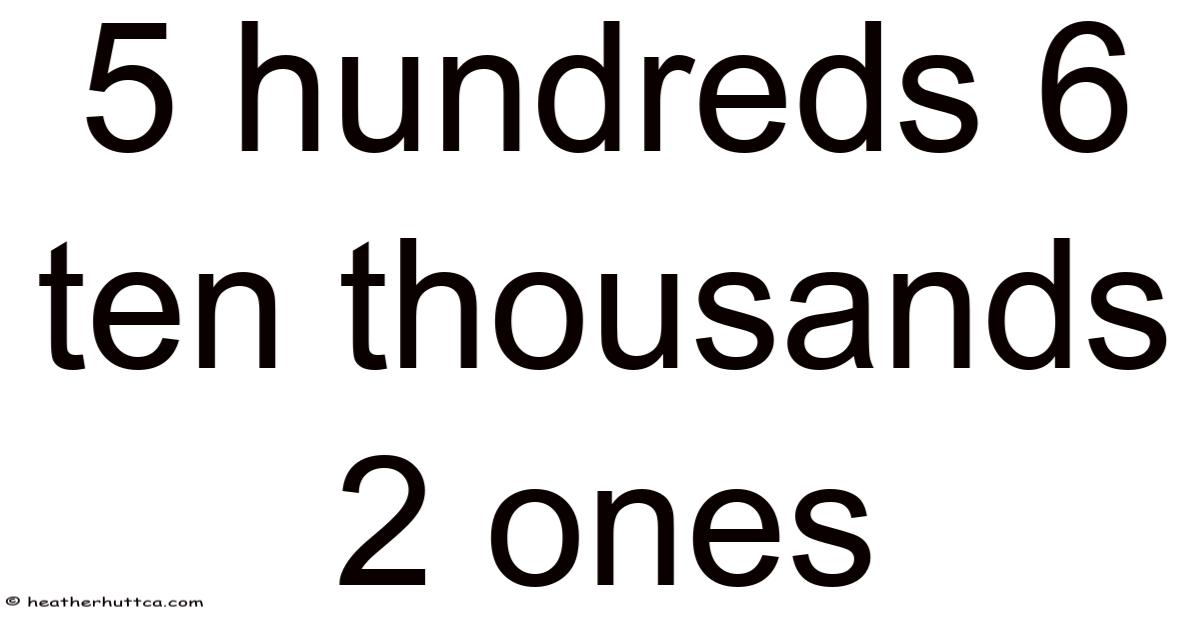
5 hundreds 6 ten thousands 2 ones is a way to describe a number using its place value components, resulting in the number 60,502. Understanding how numbers are broken down into their individual parts is a fundamental skill in mathematics that helps with reading, writing, and working with large numbers. This type of description is often used in elementary education to build number sense and to help students grasp the concept of place value, which is the foundation for all arithmetic operations The details matter here. Surprisingly effective..
Understanding Place Value
Place value is the system that assigns a specific value to a digit based on its position within a number. In the decimal number system, each position represents a power of ten. In real terms, the rightmost position is the ones place, followed by the tens, hundreds, thousands, and ten thousands places, and so on. When we say 5 hundreds 6 ten thousands 2 ones, we are identifying the value of each digit in its correct position.
Here is a breakdown of the positions for the number 60,502:
- Ten thousands place: The digit 6 is in the ten thousands place. This means it represents 6 groups of ten thousand, which is 60,000.
- Thousands place: There is no digit in the thousands place. This is represented by a zero.
- Hundreds place: The digit 5 is in the hundreds place. This represents 5 groups of one hundred, which is 500.
- Tens place: There is no digit in the tens place. This is also represented by a zero.
- Ones place: The digit 2 is in the ones place. This represents 2 single units.
By combining these values, we get: 60,000 (from the ten thousands) + 500 (from the hundreds) + 2 (from the ones) = 60,502.
How to Read the Number
Reading a number aloud requires understanding its place value. For 60,502, we can say it in two common ways:
- Sixty thousand, five hundred and two.
- Sixty thousand, five hundred two.
The word "and" is sometimes used in formal English to indicate the decimal point, but in everyday speech, it is common to omit it when reading whole numbers. The key is to group the digits by their place value and say the number in a natural, flowing way Simple, but easy to overlook..
Writing the Number in Standard and Expanded Form
Standard Form
The standard form of a number is simply the way it is written with digits. For this example, the standard form is: 60,502
Expanded Form
The expanded form shows the value of each digit separately. This is a crucial step in understanding how the number is constructed. For 60,502, the expanded form is: 60,000 + 500 + 2
Sometimes, expanded form is written with the place value names included: 6 × 10,000 + 5 × 100 + 2 × 1
This form is particularly useful in teaching because it makes the contribution of each digit clear. Take this case: it shows that the 6 is not just a six, but a six in the ten thousands place, contributing 60,000 to the total.
Real-Life Examples of 60,502
Numbers like 60,502 appear in many everyday contexts. Recognizing these numbers helps to make math feel relevant and practical.
- Population: A small town might have a population of approximately 60,502 people. Census data often reports numbers in this range.
- Distance: The distance between two cities could be 60,502 meters (or about 60.5 kilometers).
- Money: A large company might report a revenue of $60,502 for a specific quarter.
- Counting: A factory might produce 60,502 items in a single month.
In each of these examples, understanding the place value helps to quickly comprehend the magnitude of the number. As an example, knowing that the "6" is in the ten thousands place immediately tells you the number is in the sixty-thousands range The details matter here..
Why Place Value Matters
Learning to identify and use place value is one of the most important skills in mathematics. It is the basis for all operations, including addition, subtraction, multiplication, and division.
- Addition and Subtraction: When adding or subtracting large numbers, you must align the digits by their place value. To give you an idea, to add 60,502 and 3,498, you would start by adding the ones (2 + 8 = 10), then the tens (0 + 9 = 9), then the hundreds (5 + 4 = 9), and so on.
- Multiplication: When multiplying by a power of ten, you shift the digits to the left. Take this: multiplying 60,502 by 10 results in 605,020.
- Reading Large Numbers: Place value helps you read numbers with many digits without getting lost. Take this: 1,000,502 is read as "one million, five hundred two."
By mastering place value, students develop a strong number sense, which allows them to estimate, compare, and solve problems more efficiently.
Common Questions About Place Value
What is the difference between the hundreds and the thousands place? The hundreds place is three positions from the right (representing 100), while the thousands place is four positions from the right (representing 1,000). In the number 60,502, the thousands place is empty (represented by a zero).
How do you write 60,502 in words? In words, 60,502 is written as sixty thousand, five hundred two No workaround needed..
Why is there a zero in the thousands and tens place? The zeros in the thousands and tens places are placeholders. They indicate that there are no thousands or tens in the number. Without these zeros, the number would be written as 6 5 2, which would be incorrect and confusing Worth knowing..
Can place value be used for numbers larger than ten thousands? Yes, place value extends infinitely. After ten thousands comes hundred thousands, then millions, ten millions, and so on. To give you an idea, 1,605,020 has a "1" in the millions place.
What is the value of the digit 5 in 60,502? The digit 5 is in the hundreds place, so its value
is five hundred.
Real-World Applications of Place Value
Place value isn't just a concept learned in the classroom—it has numerous practical applications in everyday life.
- Finance: When budgeting or reading bank statements, understanding place value helps you quickly interpret amounts like $60,502 as sixty thousand, five hundred two dollars, rather than getting confused by the individual digits.
- Science and Engineering: Large measurements, such as distances in space or microscopic scales, rely on place value to express magnitudes accurately.
- Data Analysis: In statistics and data science, reading and interpreting large datasets requires a solid understanding of place value to make sense of numbers in the thousands, millions, or billions.
Tips for Mastering Place Value
- Practice with Number Lines: Visualizing numbers on a number line helps reinforce the relative size of digits in different places.
- Use Place Value Charts: These charts break down numbers by their positions, making it easier to see the value of each digit.
- Write Numbers in Expanded Form: Breaking a number like 60,502 into 60,000 + 500 + 2 reinforces the value of each digit.
- Play Number Games: Games like "What's the value?" or rounding challenges can make learning place value engaging and fun.
Conclusion
Place value is the cornerstone of our number system. It allows us to understand the magnitude of numbers, perform mathematical operations accurately, and communicate quantitative information clearly. Whether you're reading a phone number, calculating a budget, or solving a complex equation, place value is at work behind the scenes. Now, by mastering this fundamental concept, students and learners of all ages build a strong foundation for future mathematical success. Understanding that in 60,502, the "6" represents sixty thousand, the "5" represents five hundred, and the "2" represents two is more than just memorizing—it's unlocking the language of numbers itself.
