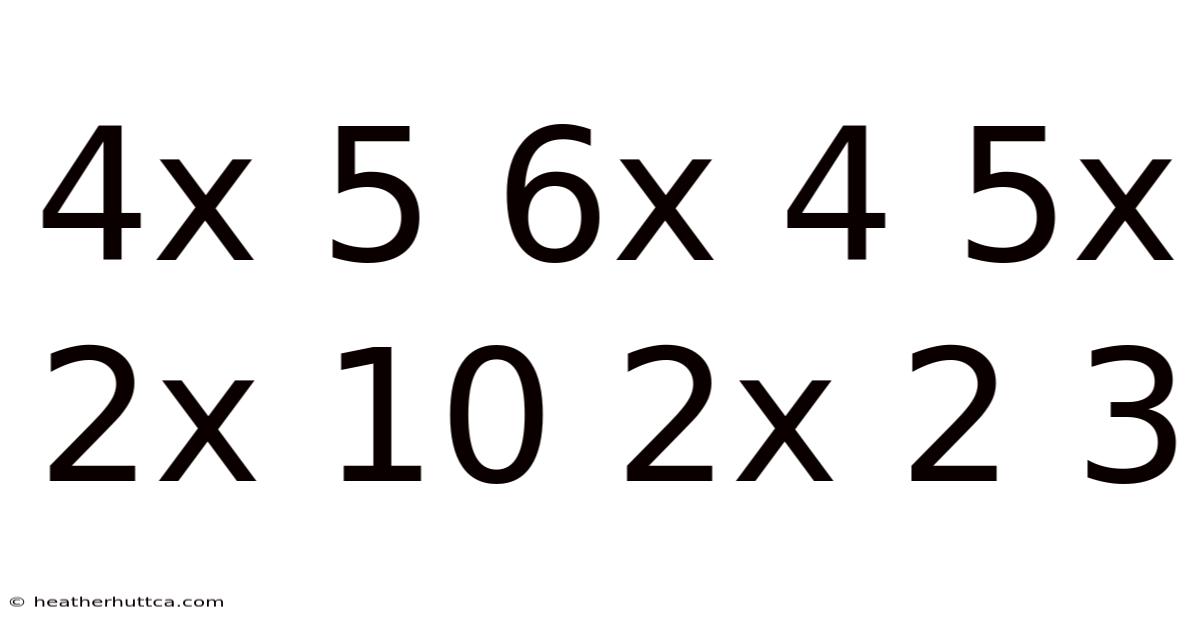
Understanding MultiplicationExpressions: 4x5, 6x4, 5x2x10, and 2x2x3
Multiplication is one of the fundamental operations in mathematics, forming the basis for more complex calculations in algebra, science, and everyday problem-solving. These expressions are not only practical for quick calculations but also serve as building blocks for understanding how numbers interact in mathematical contexts. Whether you are a student learning multiplication for the first time or someone revisiting these concepts, mastering these expressions can enhance your numerical fluency. On the flip side, the expressions 4x5, 6x4, 5x2x10, and 2x2x3 represent simple yet essential multiplication problems that can be solved using basic arithmetic principles. This article will break down each expression step by step, explain the underlying mathematical principles, and address common questions to provide a comprehensive understanding That alone is useful..
Breaking Down Each Expression: Step-by-Step Solutions
The first step in solving any multiplication expression is to identify the numbers involved and apply the multiplication operation systematically. Let’s examine each of the given expressions individually Which is the point..
Starting with 4x5, this is a straightforward multiplication of two single-digit numbers. So multiplying 4 by 5 gives 20. Plus, this result is derived from repeated addition—4 added five times (4+4+4+4+4=20) or vice versa. The simplicity of this expression makes it an ideal starting point for understanding multiplication.
Next is 6x4. Similar to the previous example, this involves multiplying two single-digit numbers. Calculating 6 multiplied by 4 yields 24 That alone is useful..
Building upon these foundational tasks, multiplication becomes a versatile tool for navigating diverse mathematical challenges. Such proficiency not only solidifies computational accuracy but also cultivates analytical thinking, bridging abstract concepts with tangible outcomes. Consider this: by integrating such insights, learners access pathways to more sophisticated problem-solving, ensuring continuous growth. Think about it: thus, embracing such knowledge empowers mastery, paving the way for further exploration. A well-rounded grasp thus emerges, anchoring understanding in practicality. Concluding, such insights remain vital for holistic mathematical proficiency.
Breaking Down Each Expression: Step-by-Step Solutions (Continued)
Let’s look at 5x2x10. This demonstrates the importance of order of operations – often remembered by the acronym PEMDAS (Parentheses, Exponents, Multiplication and Division, Addition and Subtraction). Then, we multiply the result (10) by 10, yielding 100. This expression presents a slightly more complex scenario. We can solve it by performing the multiplication in order. Which means first, we calculate 5 multiplied by 2, which equals 10. While not explicitly present here, understanding this principle is crucial for tackling more complex multiplication problems Worth keeping that in mind..
Finally, we address 2x2x3. Which means this expression involves multiplying three numbers together. Here's the thing — we first calculate 2 multiplied by 2, which equals 4. Then, we multiply the result (4) by 3, giving us 12. This demonstrates that multiplication can be broken down into smaller, manageable steps, making complex calculations less daunting.
Common Questions and Further Exploration
Several common questions arise when tackling these expressions. While both operations involve repeated subtraction, multiplication is generally considered a faster and more efficient method for calculating the same result. Worth adding: one frequent query is about the difference between multiplication and division. On top of that, another question often revolves around understanding the concept of factors and multiples. Factors are numbers that can be multiplied together to produce a given product, while multiples are the results of repeatedly multiplying a number by itself.
Beyond that, these basic multiplication expressions serve as a springboard for understanding more advanced concepts like exponentiation and the distributive property. In real terms, for instance, 5x2x10 can be rewritten as (5x2)x10, which is 10x10, or 100. This illustrates the distributive property, a cornerstone of algebraic manipulation Worth knowing..
Conclusion
All in all, the seemingly simple multiplication expressions 4x5, 6x4, 5x2x10, and 2x2x3 are far more than just rote calculations. Here's the thing — they are fundamental building blocks for mathematical understanding, fostering computational skills and analytical thinking. By breaking down these expressions into smaller, manageable steps and understanding the underlying principles, learners can develop a solid foundation in multiplication. Also worth noting, grasping these concepts unlocks pathways to more complex mathematical challenges and cultivates a deeper appreciation for the power and versatility of mathematics. Mastering these basic expressions isn't just about getting the right answer; it's about developing a dependable framework for mathematical problem-solving that will serve you well throughout your academic and professional life. Because of this, consistent practice and a willingness to explore further will undoubtedly lead to enhanced numerical fluency and a stronger overall mathematical understanding That alone is useful..
Expanding on theseelementary calculations opens doors to a host of practical scenarios that rarely receive attention in a classroom setting. On top of that, similarly, when budgeting for a small business, multiplying unit costs by quantities—such as 7 × 15 for the cost of fifteen items priced at seven dollars each—provides an instant snapshot of expenses. Imagine you are planning a community event and need to determine the total number of chairs required: if each table seats four people and you have twelve tables, the problem reduces to a straightforward 4 × 12 computation. Even in everyday cooking, scaling a recipe up or down hinges on proportional multiplication; doubling a sauce that calls for 2 × 3 × 5 milliliters of three ingredients simply means multiplying each component by two and then recombining the results.
These operations also lay the groundwork for more abstract mathematical ideas. Now, in data analysis, multiplying frequencies by values produces weighted averages, a technique that surfaces in statistics and economics. On top of that, in geometry, the area of a rectangle is found by multiplying its length by its width; a 6 × 4 grid of squares, for instance, yields 24 unit squares, a direct application of the same principles explored earlier. On top of that, understanding how to decompose a product into smaller factors aids in simplifying algebraic expressions—for example, rewriting 12 × 8 × 5 as (12 × 8) × 5 or as 12 × (8 × 5) showcases the associative property in action, a cornerstone for manipulating equations efficiently Worth knowing..
To solidify these connections, try challenging yourself with real‑world problems that require chaining multiple multiplications. Plus, suppose you are organizing a charity drive and need to calculate the total number of donated books: if each box holds 9 books, you receive 7 boxes, and each box is duplicated 3 times for different locations, the overall count is 9 × 7 × 3. Working through such layered scenarios not only reinforces computational fluency but also cultivates logical reasoning and problem‑solving agility.
By consistently applying these multiplication strategies to tangible situations, learners bridge the gap between abstract symbols and meaningful outcomes. This practice transforms rote memorization into purposeful skill, empowering individuals to approach more sophisticated mathematical concepts with confidence and curiosity Not complicated — just consistent. Worth knowing..
Final Takeaway
Mastering basic multiplication equips you with a versatile toolkit that extends far beyond textbook exercises. Whether you are planning events, managing finances, or exploring scientific data, the ability to break down and recombine products streamlines complex tasks and sharpens analytical thinking. Embrace continual practice, seek out diverse applications, and let each multiplication problem become a stepping stone toward deeper mathematical insight Less friction, more output..
This practical fluency also enhances digital literacy, as spreadsheets and coding scripts often rely on efficient loops and array operations rooted in these fundamental calculations. When you automate repetitive tasks—such as generating monthly reports or simulating financial scenarios—understanding the underlying multiplicative relationships ensures that your models remain accurate and scalable. In programming, for instance, nested loops that iterate over rows and columns mirror the grid model of multiplication, translating abstract math into functional code with real-time outputs.
Adding to this, the skill fosters adaptability in an ever-evolving technological landscape. Day to day, modern tools may change, but the logic behind multiplication remains constant, allowing you to interpret new software, evaluate algorithmic recommendations, and make informed decisions based on data trends. Whether you are adjusting a budget forecast or optimizing a delivery route, the ability to quickly estimate and verify calculations prevents costly errors and builds trust in your analytical conclusions Simple, but easy to overlook..
The bottom line: embracing multiplication as a dynamic, applied discipline rather than a static chore transforms how you engage with the world. It encourages a mindset of precision, pattern recognition, and structured problem-solving that applies across disciplines. Still, by integrating these principles into daily challenges, you not only refine numerical agility but also develop a resilient approach to complex systems. Let each multiplication exercise serve as a foundation for innovation, empowering you to deal with both academic pursuits and real‑world demands with clarity and confidence.
