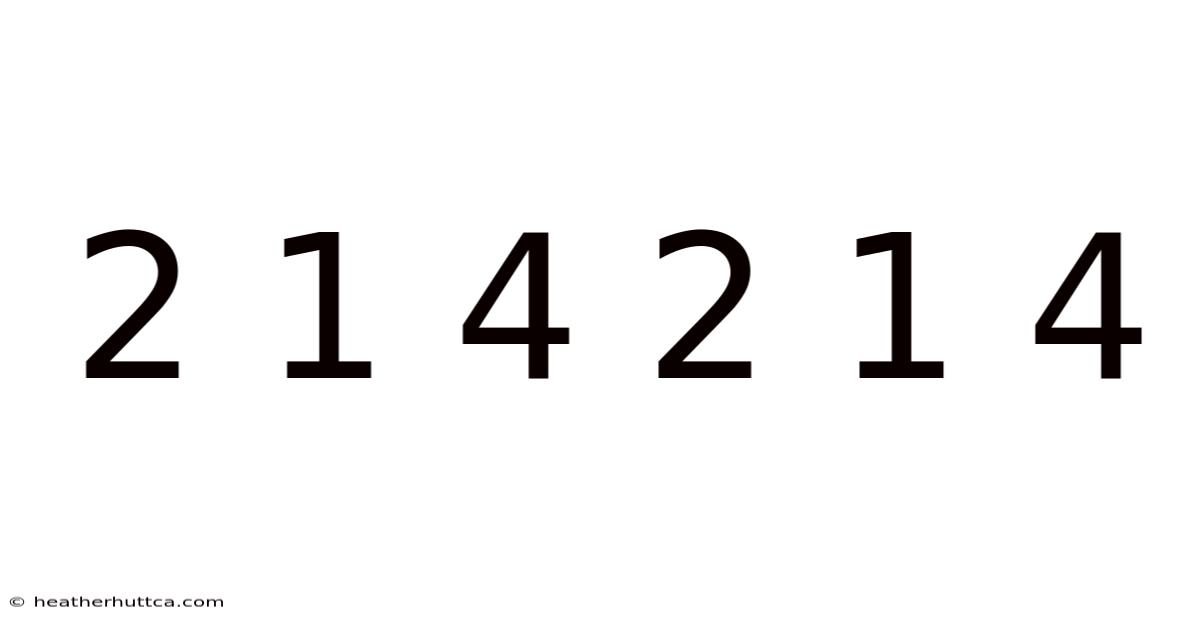
The sequence 2 1 4 2 1 4 may appear simple at first glance, but it contains a fascinating pattern that has captured the attention of mathematicians, educators, and puzzle enthusiasts alike. This article explores the structure, significance, and applications of this repeating numerical pattern, offering insights that go beyond its surface simplicity Small thing, real impact. Less friction, more output..
Not obvious, but once you see it — you'll see it everywhere.
Understanding the Pattern
At its core, the sequence 2 1 4 2 1 4 is a repeating cycle of six digits. The pattern begins with 2, followed by 1, then 4, and then repeats: 2, 1, 4, and so on. This creates a loop that, when extended, looks like: 2 1 4 2 1 4 2 1 4 2 1 4…
The simplicity of this pattern makes it a great tool for teaching basic concepts in mathematics, such as sequences, repetition, and modular arithmetic. It can also serve as a stepping stone for more advanced topics, like period detection in number theory or algorithmic thinking Small thing, real impact..
You'll probably want to bookmark this section.
Mathematical Properties
Worth mentioning: interesting aspects of this sequence is its periodicity. The period here is 3, meaning the pattern repeats every three numbers. This is because the sequence is essentially a cycle of three distinct numbers: 2, 1, and 4.
If we assign each number a position in the cycle, we can describe the sequence using modular arithmetic:
- Position 1: 2
- Position 2: 1
- Position 3: 4
Then it repeats: Position 4 is again 2, Position 5 is 1, and so forth. This makes the sequence predictable and easy to extend indefinitely The details matter here. And it works..
Applications in Education
Educators often use simple repeating patterns like 2 1 4 2 1 4 to introduce students to the concept of sequences. - Understand the concept of cycles and periodicity. Still, by analyzing the pattern, students learn to:
- Identify repetition and predict future terms. - Develop logical reasoning and pattern recognition skills.
Here's one way to look at it: a teacher might ask students to continue the sequence or to find the 100th term. Using modular arithmetic, students can quickly determine that the 100th term is 4, since 100 divided by 3 leaves a remainder of 1, corresponding to the third position in the cycle.
Real-World Connections
While the sequence may seem abstract, similar repeating patterns appear in various real-world contexts. For instance:
- Music: Rhythmic patterns often repeat in cycles, much like this numerical sequence.
- Computer Science: Algorithms that use cyclic buffers or repeating keys in cryptography rely on similar principles.
- Nature: Many natural phenomena, such as seasonal cycles or biological rhythms, exhibit periodic behavior.
This changes depending on context. Keep that in mind.
By studying simple patterns like 2 1 4 2 1 4, learners can develop an intuition for recognizing and working with more complex periodic systems Small thing, real impact..
Exploring Variations
Mathematicians and educators sometimes explore variations of this pattern to deepen understanding. For example:
- What if we change one number in the sequence? And - Can we create a new sequence by adding a constant to each term? How does that affect the overall pattern?
- What happens if we reverse the order or apply a function to each term?
These explorations encourage creative thinking and help students see mathematics as a dynamic and flexible field The details matter here..
Frequently Asked Questions
What is the 10th term in the sequence 2 1 4 2 1 4? The sequence repeats every three terms. The 10th term corresponds to the first position in the cycle, which is 2 Surprisingly effective..
How can I find the nth term without listing all previous terms? Use modular arithmetic. Divide n by 3 and use the remainder to determine the position in the cycle.
Is there a formula for this sequence? Yes, if we let a(n) be the nth term, then a(n) = [2, 1, 4][(n-1) mod 3], where the brackets indicate selecting from the list [2, 1, 4].
Can this pattern be used in coding or algorithms? Absolutely. Such patterns are often used in programming for tasks like generating test data, creating cyclic animations, or implementing round-robin scheduling.
Conclusion
The sequence 2 1 4 2 1 4 is more than just a string of numbers. It is a gateway to understanding fundamental concepts in mathematics, such as periodicity, modular arithmetic, and pattern recognition. Its simplicity makes it accessible to learners of all ages, while its underlying structure offers depth for those who wish to explore further.
Whether used in the classroom, in puzzles, or as a model for real-world cycles, this pattern demonstrates the beauty and utility of mathematics in everyday life. By studying such sequences, we not only sharpen our analytical skills but also develop an appreciation for the order and predictability that underlie much of the world around us Easy to understand, harder to ignore..
