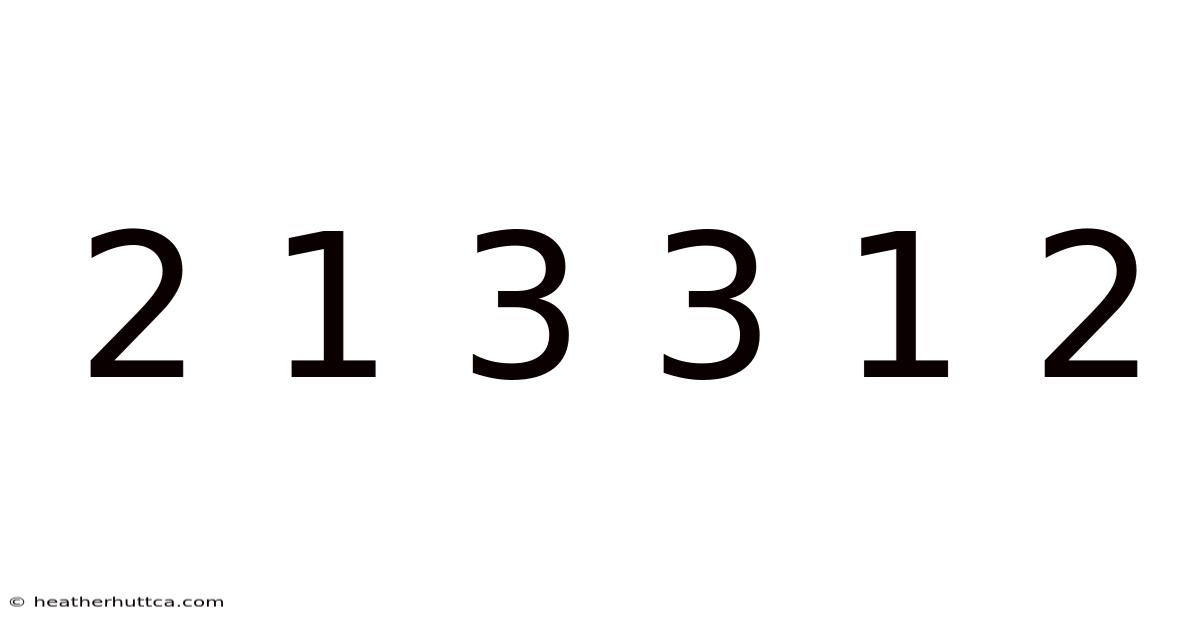
Understanding the 2-1-3-3-1-2 Pattern: A Deep Dive into Mathematical Sequences and Rhythmic Structures
The sequence 2 1 3 3 1 2 may appear at first glance to be a random string of digits, but in the realms of mathematics, music theory, and pattern recognition, such arrangements often hide profound symmetries and structural logic. Whether viewed as a palindrome (a sequence that reads the same forward and backward) or as a rhythmic blueprint for a musical composition, the 2 1 3 3 1 2 pattern serves as a perfect case study in how humans perceive order within numerical data. Understanding these patterns helps us develop critical thinking skills and a deeper appreciation for the mathematical harmony that governs the natural world.
Introduction to Numerical Symmetry
At its core, the sequence 2 1 3 3 1 2 is a symmetric arrangement. That said, in mathematics, symmetry occurs when a shape or a sequence remains unchanged after a transformation, such as reflection. If you place a mirror in the center of this sequence—between the two 3s—the left side is a perfect reflection of the right And that's really what it comes down to. But it adds up..
This specific type of symmetry is known as bilateral symmetry. While we often associate symmetry with visual arts or biology (like the wings of a butterfly), numerical symmetry is the foundation of many complex algorithms and algebraic structures. When we encounter a pattern like 2 1 3 3 1 2, our brains instinctively seek a "rule" or a "formula" that explains why the numbers are arranged this way, triggering a cognitive process known as pattern matching That's the part that actually makes a difference..
No fluff here — just what actually works.
The Mathematical Perspective: Sequences and Series
In the study of sequences, we look for the relationship between one term and the next. Let's analyze the transitions in 2 1 3 3 1 2:
- From 2 to 1: A decrease of 1 (-1).
- From 1 to 3: An increase of 2 (+2).
- From 3 to 3: No change (0).
- From 3 to 1: A decrease of 2 (-2).
- From 1 to 2: An increase of 1 (+1).
When we map these changes (-1, +2, 0, -2, +1), we see another layer of symmetry. The changes themselves are mirrored around the center point. This suggests that the sequence is not linear (growing in one direction) but cyclical or reflective.
Potential Applications in Combinatorics
In combinatorics, the study of counting and arrangement, a sequence like this could represent a specific path on a grid or a set of instructions for a permutation. As an example, if these numbers represented steps in different directions (North, South, East, West), the symmetry of 2 1 3 3 1 2 would check that the "traveler" returns to a specific relative position, creating a closed loop or a balanced movement That's the whole idea..
The Rhythmic and Musical Interpretation
Beyond the chalkboard, the sequence 2 1 3 3 1 2 finds a vibrant home in music theory. So music is essentially mathematics made audible. Rhythms are built on the division of time into specific intervals, and a sequence of numbers can easily be translated into a rhythmic motif The details matter here..
Imagine each number representing the number of beats or the length of a note:
- 2: Two quarter notes (Steady)
- 1: One quarter note (Quick)
- 3: Three quarter notes or a dotted half note (Extended)
- 3: Three quarter notes (Extended)
- 1: One quarter note (Quick)
- 2: Two quarter notes (Steady)
When played, this creates a "swelling" effect. That said, this is a common technique used in composition to create tension and release. The rhythm starts stable, tightens in the middle, expands at the center (the 3s), and then contracts back to its original state. The symmetry provides the listener with a sense of resolution; the ear recognizes that the piece has returned to where it started, providing psychological satisfaction.
Cognitive Psychology: Why We Love Patterns
Why does a sequence like 2 1 3 3 1 2 feel more "correct" or "pleasing" than a sequence like 4 7 2 9 1 5? On the flip side, the answer lies in Gestalt Psychology. The human mind is wired to organize visual or numerical stimuli into the simplest form possible Small thing, real impact..
- The Law of Prägnanz: This law suggests that we perceive ambiguous or complex images as the simplest form possible. A symmetric sequence is "simpler" for the brain to process because it only needs to memorize half of the sequence; the other half is simply a reflection.
- Predictability and Comfort: Patterns reduce cognitive load. When we see 2 1 3..., and then see ...3 1 2, our brain experiences a "click" of recognition. This release of tension is why we enjoy puzzles, poetry, and rhythmic music.
Step-by-Step: How to Create Your Own Symmetric Sequences
If you want to apply the logic of the 2 1 3 3 1 2 pattern to your own work—whether in coding, art, or music—follow these steps:
- Define Your Core: Choose a center point. In our example, the center is the pair of 3s.
- Establish the Lead-in: Pick a set of numbers that create a specific "mood" or "direction." For example: 5, 2, 8.
- Mirror the Sequence: Reverse the lead-in and place it after the core.
- Lead-in: 5, 2, 8
- Core: 4, 4
- Mirror: 8, 2, 5
- Result: 5 2 8 4 4 8 2 5
- Test for Balance: Read the sequence forward and backward. If it remains identical, you have successfully created a numerical palindrome.
FAQ: Frequently Asked Questions
Is 2 1 3 3 1 2 a prime sequence?
No, a "prime sequence" usually refers to a sequence consisting only of prime numbers. While 2 and 3 are prime, 1 is not considered a prime number in modern mathematics And that's really what it comes down to..
Can this sequence be used in computer programming?
Yes. Symmetric sequences are often used in data validation and checksums. Additionally, palindromic logic is a fundamental exercise for students learning about strings and arrays in languages like Python or Java.
Does this pattern appear in nature?
While this exact sequence may not be a universal constant, the concept of symmetry (bilateral and radial) is everywhere—from the structure of DNA to the arrangement of petals on a flower.
Conclusion: The Beauty of Order
The sequence 2 1 3 3 1 2 is more than just a collection of digits; it is a reflection of the fundamental human desire for balance and order. By analyzing it through the lenses of mathematics, music, and psychology, we discover that symmetry is a universal language. Whether it is used to create a catchy beat in a song, a balanced architectural design, or an efficient piece of code, the principle of the mirrored sequence remains a powerful tool for creation and understanding Worth keeping that in mind..
By training ourselves to spot these patterns, we enhance our ability to solve complex problems and see the hidden connections in the world around us. Practically speaking, the next time you encounter a string of numbers, ask yourself: *Is there a mirror here? In real terms, is there a rhythm? * You might be surprised by the harmony you find.
