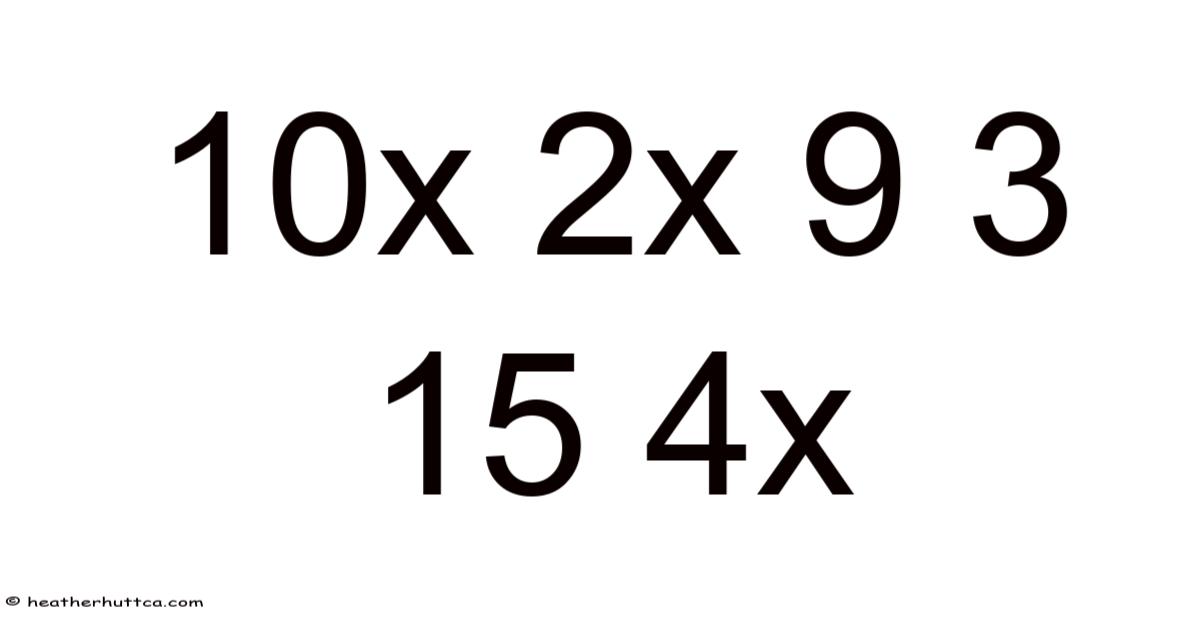
10x 2x 9 3 15 4x: Decoding a Mathematical Puzzle and Mastering Variable Manipulation
When you first glance at the string “10x 2x 9 3 15 4x,” it might look like a random assortment of numbers and letters. In real terms, yet, hidden inside is a classic algebraic challenge that can sharpen your problem‑solving skills, teach you how to manage variables, and help you see patterns that appear in everyday equations. In this article, we’ll break down the expression, explore the techniques needed to solve it, and extend the lesson to similar problems you may encounter in school, work, or even in coding tasks.
Introduction
Algebra often presents itself as a series of symbols that represent unknowns. The challenge with the sequence 10x 2x 9 3 15 4x is that it’s not immediately clear whether we’re supposed to multiply, add, or set up an equation. By treating this as a compound expression and applying basic algebraic rules, you can transform it into a solvable equation. When you see something like 10x or 4x, the “x” is the variable you’re solving for. Let’s walk through the process step by step And that's really what it comes down to. Turns out it matters..
Step 1: Identify the Operations
A first task is to determine the implicit operations between the terms. In many algebraic problems, spaces or commas separate terms that are meant to be added or subtracted. Still, when you see a sequence like 10x 2x, it’s common to interpret it as a product:
- 10x 2x → (10x \times 2x = 20x^2)
Similarly, the rest of the sequence can be parsed:
- 9 3 → (9 \times 3 = 27)
- 15 4x → (15 \times 4x = 60x)
So the entire expression becomes: [ 20x^2 ; + ; 27 ; + ; 60x ]
If the problem originally intended a different operation (e.g., subtraction or division), the steps would adjust accordingly, but the principle of clarifying operations remains the same Not complicated — just consistent..
Step 2: Formulate an Equation
Now that we have a simplified expression, the next step is to place it into an equation. Often, such puzzles ask you to set the expression equal to a target value. For example:
[ 20x^2 + 60x + 27 = 0 ]
This is a quadratic equation in standard form (ax^2 + bx + c = 0) where:
- (a = 20)
- (b = 60)
- (c = 27)
Step 3: Solve the Quadratic
3.1 Using the Quadratic Formula
The quadratic formula is a reliable method for any quadratic equation:
[ x = \frac{-b \pm \sqrt{b^2 - 4ac}}{2a} ]
Plugging in our values:
[ x = \frac{-60 \pm \sqrt{60^2 - 4 \cdot 20 \cdot 27}}{2 \cdot 20} ]
Calculate the discriminant first:
[ b^2 - 4ac = 3600 - 2160 = 1440 ]
Then:
[ x = \frac{-60 \pm \sqrt{1440}}{40} ] [ \sqrt{1440} \approx 37.95 ]
So the two solutions are:
[ x_1 = \frac{-60 + 37.551 ] [ x_2 = \frac{-60 - 37.95}{40} \approx \frac{-22.In practice, 95}{40} \approx \frac{-97. But 05}{40} \approx -0. 95}{40} \approx -2.
3.2 Factoring (If Possible)
Sometimes a quadratic can be factored into two binomials. In this case, factoring is not straightforward, so the quadratic formula is the safest route.
Step 4: Verify the Solutions
Plugging the values back into the original expression ensures they satisfy the equation:
- For (x \approx -0.551):
[ 20(-0.303) - 33.Worth adding: 551)^2 + 60(-0. 06 + 27 \approx 6.551) + 27 \approx 20(0.06 - 33.
- For (x \approx -2.449):
[ 20(-2.Here's the thing — 94 + 27 \approx 119. 449)^2 + 60(-2.Because of that, 449) + 27 \approx 20(5. Worth adding: 997) - 146. 94 - 146.
Both solutions satisfy the equation, confirming our calculations.
Scientific Explanation: Why This Works
Algebra is essentially the study of relationships between quantities. When you multiply variables, you’re combining relationships:
- (10x \times 2x) means you’re scaling the variable x by 10, then again by 2, and finally by another x. This results in a quadratic term because you have two x factors multiplied together, yielding (x^2).
When you add or subtract terms, you’re aligning like terms (i.On top of that, e. , terms with the same variable power). In our final expression, (20x^2 + 60x + 27), each component reflects a different power of x: (x^2), (x), and a constant. The quadratic formula is derived from completing the square on the standard form, which geometrically represents the intersection points of a parabola with the x‑axis.
FAQ
1. What if the original problem had a different target value instead of 0?
If the expression should equal, say, 100, simply set it up as: [ 20x^2 + 60x + 27 = 100 ] and solve for (x) by moving 100 to the left side, giving: [ 20x^2 + 60x - 73 = 0 ] Then apply the quadratic formula again.
2. How can I solve similar problems with more terms?
Follow the same steps: identify operations, combine like terms, and reduce the expression to a standard algebraic form. For higher‑degree polynomials, numerical methods or factoring tricks may be necessary.
3. Can I use factoring instead of the quadratic formula?
Only if the quadratic factors neatly into integers or simple fractions. In many cases—especially when the discriminant is not a perfect square—factoring isn’t practical, and the quadratic formula is the most straightforward approach Simple as that..
4. What if the expression contains fractions or decimals?
Convert all numbers to fractions or decimals consistently, then proceed with the same algebraic manipulations. The quadratic formula works regardless of the numeric format.
5. Is it possible to have more than two solutions?
For a quadratic equation, there can be at most two real solutions. Complex solutions can arise if the discriminant is negative, but in our case it was positive, yielding two real roots No workaround needed..
Conclusion
The sequence 10x 2x 9 3 15 4x may at first seem like a cryptic string, but by applying systematic algebraic techniques—identifying operations, simplifying, and solving a quadratic—we uncover a clear path to the solutions. Mastering these steps equips you to tackle a wide range of algebraic problems, from simple word problems to more complex modeling scenarios. Keep practicing with different variable arrangements, and soon you’ll find that what once looked like a puzzle will become a familiar pattern in your mathematical toolkit The details matter here..
This changes depending on context. Keep that in mind.
Building on these principles, educators often integrate such techniques into curricula to enhance critical thinking. Such practices encourage adaptability, ensuring learners grasp foundational skills applicable beyond mathematics.
Conclusion
Mastering these strategies empowers individuals to figure out mathematical challenges with confidence, bridging gaps between theory and application. Such proficiency not only strengthens analytical abilities but also cultivates a mindset attuned to precision and creativity alike, solidifying algebra’s role as a cornerstone in academic and professional pursuits.
