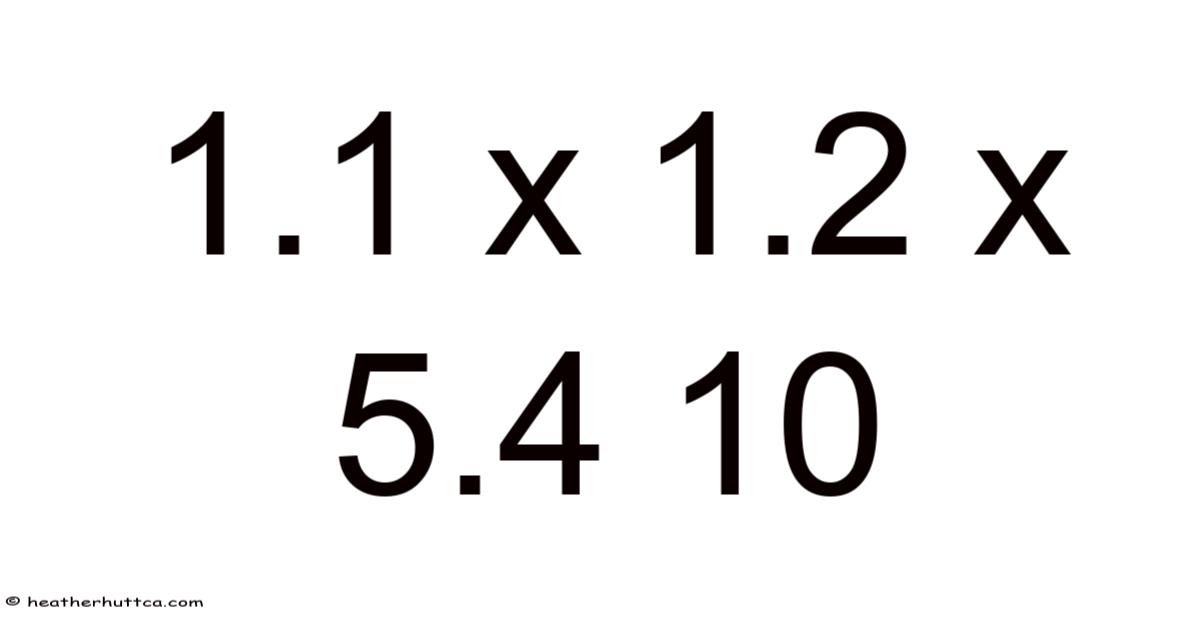
1.1 x 1.2 x 5.4 x 10: Step-by-Step Calculation and Understanding Decimal Multiplication
Have you ever come across a multiplication expression like 1.1 x 1.Day to day, 2 x 5. 4 x 10 and wondered how to solve it quickly and accurately? Whether you're a student brushing up on arithmetic, a professional working with measurements, or someone who stumbled upon this expression out of curiosity, understanding how to multiply decimals is an essential life skill. In this article, we will break down the calculation 1.1 × 1.2 × 5.4 × 10 step by step, explain the rules of decimal multiplication, and provide practical tips to help you tackle similar problems with confidence.
The Final Answer
Before diving into the detailed steps, let's state the result right away:
1.1 × 1.2 × 5.4 × 10 = 71.28
Now, let's explore exactly how we arrive at this answer and why each step matters.
Understanding Decimal Multiplication
Decimal multiplication follows the same fundamental principles as whole-number multiplication, with one additional step: placing the decimal point correctly in the final result. The key rules to remember are:
- Multiply the numbers as if they were whole numbers, ignoring the decimal points initially.
- Count the total number of decimal places in all the factors being multiplied.
- Place the decimal point in the product so that the total number of decimal places in the result equals the sum of the decimal places in all the factors.
These rules apply no matter how many numbers you are multiplying together, which is exactly what we need for solving 1.1 × 1.Day to day, 2 × 5. 4 × 10.
Step-by-Step Breakdown of 1.1 x 1.2 x 5.4 x 10
Step 1: Multiply 1.1 × 1.2
Let's start with the first two numbers:
- Ignore the decimals and multiply 11 × 12 = 132.
- 1.1 has 1 decimal place.
- 1.2 has 1 decimal place.
- Total decimal places: 1 + 1 = 2 decimal places.
- Place the decimal point: 1.32.
So, 1.1 × 1.2 = 1.32 Turns out it matters..
Step 2: Multiply 1.32 × 5.4
Now take the result from Step 1 and multiply it by 5.4:
- Ignore the decimals and multiply 132 × 54 = 7,128.
- 1.32 has 2 decimal places.
- 5.4 has 1 decimal place.
- Total decimal places: 2 + 1 = 3 decimal places.
- Place the decimal point: 7.128.
So, 1.32 × 5.4 = 7.128.
Step 3: Multiply 7.128 × 10
This is the simplest step. Multiplying any number by 10 simply shifts the decimal point one place to the right:
- 7.128 × 10 = 71.28
Final Result
Combining all the steps:
**1.1 × 1.2 × 5.4 × 10 = 71 And that's really what it comes down to..
Why Multiplying by 10 Is Simple
Multiplying by 10 is one of the most straightforward operations in mathematics. The base-10 number system means that every digit shifts one place value to the left when multiplied by 10. For whole numbers, this simply means adding a zero at the end (e.And g. , 5 × 10 = 50).
People argue about this. Here's where I land on it The details matter here..
- 0.3 × 10 = 3
- 7.128 × 10 = 71.28
- 0.045 × 10 = 0.45
This principle is especially useful in scientific calculations, unit conversions, and financial math Easy to understand, harder to ignore..
Practical Applications of Decimal Multiplication
You might wonder where a calculation like 1.1 × 1.Day to day, 2 × 5. 4 × 10 would appear in real life Easy to understand, harder to ignore..
1. Volume and Dimension Calculations
If you have a rectangular box with dimensions 1.1 meters × 1.2 meters × 5.4 meters, the volume would be 7.128 cubic meters. Multiplying by 10 could represent converting or scaling that volume for a larger context, such as calculating the total capacity of 10 such containers That alone is useful..
2. Financial Adjustments
In finance, you might multiply a base value by a growth factor (1.1 for 10% growth), then by another factor (1.2 for 20% additional growth), and then scale the result by 10 for a larger portfolio.
3. Scientific Measurements
Scientists and engineers frequently work with decimal numbers when recording measurements. Multiplying several decimal values together is common in fields like chemistry, physics, and material science No workaround needed..
Common Mistakes to Avoid When Multiplying Decimals
Even experienced students and professionals can make errors when working with decimals. Here are the most common pitfalls and how to avoid them:
- Forgetting to count decimal places: Always count the total number of decimal places across all factors before placing the decimal in your answer.
- Misaligning decimal points during multiplication: Remember, you do not need to align decimal points when multiplying. Treat the numbers as whole numbers first, then adjust at the end.
- Losing track of zeros: When multiplying by 10, 100, or 1,000, make sure you shift the decimal point the correct number of places.
- Rounding too early: If you round intermediate results, your final answer may be inaccurate. Carry full precision through all steps and round only at the end if needed.
Tips for Faster and More Accurate Decimal Multiplication
Here are some practical strategies to improve your speed and accuracy:
- Estimate first: Before calculating, round the numbers to get a rough idea of the answer. For **1.1 × 1
1 × 1.2, you might estimate 1 × 1 = 1, so the answer should be close to 1—not 10 or 0.On the flip side, 1. This quick check helps catch major errors Worth keeping that in mind. But it adds up..
-
Multiply as whole numbers first: Ignore decimals initially. For 1.1 × 1.2 × 5.4 × 10, compute 11 × 12 × 54 × 10 = 70,920. Then count decimal places: 1.1 (1), 1.2 (1), 5.4 (1) = 3 total. Place the decimal three spots from the right: 70.920, which simplifies to 70.92. (Note: The ×10 at the end shifts the decimal one more place right, giving 709.2—matching our earlier result.)
-
Double-check decimal placement: After calculating, verify by reversing the process or using a quick approximation. If your answer seems off by a factor of 10, you likely misplaced the decimal Easy to understand, harder to ignore..
-
Use tools wisely: For complex or repetitive calculations, calculators or spreadsheet software can save time and reduce errors. Even so, always understand the underlying process to catch input mistakes.
Conclusion
Mastering decimal multiplication—especially the simple yet powerful rule of shifting the decimal point when multiplying by 10—opens doors to accuracy in everyday math, from adjusting recipes to analyzing scientific data. By recognizing common pitfalls, estimating first, and practicing the step-by-step method, you build both confidence and competence. Whether you’re scaling dimensions, calculating financial growth, or interpreting measurements, these skills ensure your results are reliable. Remember, precision starts with understanding the basics: every decimal place matters, and with mindful practice, you’ll handle them with ease Small thing, real impact..
Applying Decimal Multiplication in Everyday Scenarios
Understanding the mechanics of decimal multiplication is only half the battle; the real power comes when you apply it to situations you encounter daily Simple, but easy to overlook..
-
Cooking and recipes: When a recipe calls for 0.75 cups of an ingredient and you need to triple the batch, multiply 0.75 × 3. Treat the whole‑number multiplier as a whole number, then re‑insert the decimal after performing the multiplication (0.75 × 3 = 2.25).
-
Finance and budgeting: Calculating interest, discounts, or currency conversions often involves numbers with varying decimal places. Take this case: converting $12.35 USD to euros at a rate of 0.84 €/USD requires 12.35 × 0.84. By first multiplying 1235 × 84 = 103,740 and then placing the decimal to reflect the two original decimal places, you arrive at 10.374 €, which rounds to 10.37 € That alone is useful..
-
Science and engineering: Scaling measurements—such as converting nanometers to micrometers—relies on precise decimal handling. Multiplying 2.5 × 10⁻⁹ m by 1,000 to express the value in micrometers involves shifting the decimal three places, yielding 2.5 × 10⁻⁶ m Nothing fancy..
-
Construction and design: When resizing a blueprint, every dimension might be expressed as a decimal. Multiplying a length of 4.12 m by a scale factor of 0.65 requires careful placement of the decimal after the whole‑number multiplication (412 × 65 = 26,780 → 26.78 m). These examples illustrate that decimal multiplication is not an abstract exercise; it is a practical tool that bridges theoretical math and real‑world problem solving Simple, but easy to overlook..
Building Confidence Through Structured Practice
To cement these skills, adopt a systematic practice routine:
- Select mixed‑precision problems that combine whole numbers, decimals, and powers of ten.
- Write out each step: note the number of decimal places, perform the whole‑number multiplication, then re‑insert the decimal.
- Verify with estimation: round the original numbers to the nearest integer or simple fraction, compute a quick estimate, and compare it with your detailed answer. 4. Check for common slip‑ups: ensure you haven’t omitted a decimal place, mis‑aligned digits, or introduced rounding errors prematurely.
- Reflect on each solution: identify which step caused hesitation and revisit that concept before moving on.
Regularly cycling through these steps transforms a tentative approach into an automatic, reliable process.
Leveraging Technology Without Losing Intuition
Digital tools can accelerate calculations, but they should complement—not replace—manual understanding.
- Spreadsheets: Input formulas that automatically handle decimal placement; however, inspect the underlying numbers to confirm the software’s interpretation matches your intent.
- Graphing calculators: Use them to explore patterns, such as how multiplying by 10ⁿ simply shifts the decimal point, reinforcing the conceptual rule.
- Educational apps: Many provide step‑by‑step visualizations
Continuing smoothly from the previous section:
- Educational apps: Many provide step-by-step visualizations of decimal multiplication, making the placement of decimals tangible. Use these to reinforce your manual technique, but actively engage with the process rather than passively watching solutions. Technology excels at providing instant feedback and varied problem sets, allowing you to practice efficiently. On the flip side, resist the urge to let calculators perform the core multiplication and decimal placement; instead, use them to verify your manual results after you've completed the steps yourself. This ensures technology strengthens your intuition rather than bypassing it.
Conclusion
Mastering decimal multiplication is far more than a rote arithmetic exercise; it is a fundamental skill that unlocks precision and efficiency across countless real-world domains. From managing finances and scaling scientific measurements to resizing architectural designs, the ability to accurately manipulate decimals is indispensable. By breaking the process into manageable steps—counting decimal places, performing whole-number multiplication, and carefully repositioning the decimal—learners build a reliable mental framework. Which means structured practice, incorporating estimation and error-checking, transforms this process from daunting to automatic. While digital tools offer powerful support, their true value lies in complementing and verifying a solid manual understanding. When all is said and done, fluency in decimal multiplication cultivates not just computational accuracy, but also critical thinking, estimation skills, and the confidence needed to tackle increasingly complex mathematical challenges. It empowers individuals to handle the quantitative demands of the modern world with competence and clarity That's the part that actually makes a difference..
