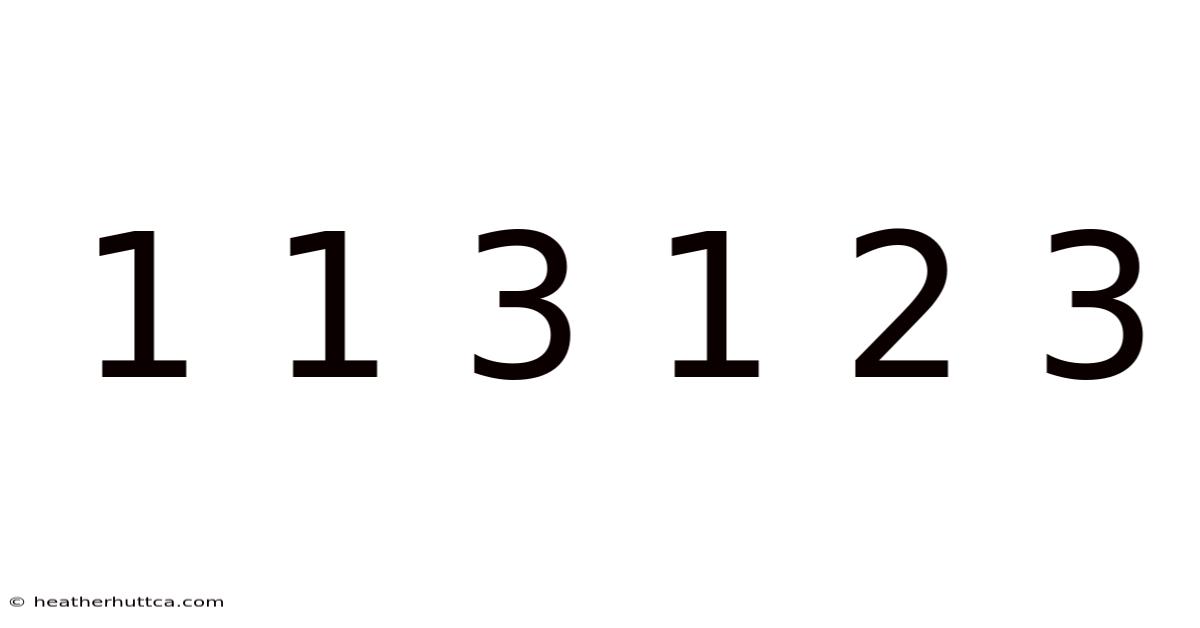
The Numbers 1, 3, 1, 2, 3 weave through the fabric of mathematics, culture, and human curiosity, serving as both simple symbols and profound representations of order, variability, and interconnectedness. Think about it: these five distinct yet interconnected figures—1, 3, 1, 2, and 3—serve as anchors in a vast tapestry of patterns that transcend their numerical simplicity. On the flip side, whether viewed through the lens of arithmetic, art, or philosophy, they invite exploration into the universal language of numbers. Their presence in equations, in myths, in daily life, underscores a shared human tendency to seek structure amid chaos. Yet, what makes these numbers particularly resonant lies in their duality: they are both foundational and fluid, static yet dynamic, solitude and unity. This article gets into the multifaceted roles these numbers play across disciplines, examining their historical significance, mathematical properties, cultural interpretations, and practical applications. By examining their interplay, we uncover insights that challenge conventional perceptions and reveal the underlying harmony that binds seemingly disparate elements.
Mathematical Foundations: The Logic Behind the Numbers
At the core of the numbers 1, 3, 1, 2, 3 lies a rich mathematical foundation that underpins much of scientific inquiry. The digit 1, symbolizing unity and simplicity, forms the bedrock of numerical systems, serving as the essential building block for all arithmetic operations. Its presence is unassailable in addition, subtraction, multiplication, and division, making it indispensable for calculations that define the precision of everyday life. Conversely, 3 emerges as a recurring motif, representing balance, creativity, and the third element in many mathematical frameworks. Its prevalence is evident in geometry, where triangles and hexagons frequently feature its presence, and in probability, where 3 often symbolizes chance or unpredictability. The number 2, though seemingly straightforward, holds dual significance—it embodies duality itself, appearing in pairs, opposites, and foundational systems like binary. Finally, 1, though minimal, acts as a counterbalance, reinforcing the concept of zero’s role in modern mathematics. Together, these numbers form a symbiotic relationship, each amplifying the others’ utility while maintaining their distinct identities. Their interdependence mirrors the interconnectedness of all systems, whether in physics, economics, or biology. Understanding their roles requires not only technical skill but also an appreciation for how small elements can collectively shape complex outcomes.
Historical Context: Echoes Through Time
The allure of 1, 3, 1, 2, 3 transcends modern mathematics, drawing roots into ancient traditions and medieval scholarship. In early civilizations, these numbers were not merely abstract concepts but tools for storytelling, record-keeping, and spiritual practice. The Sumerians, who developed one of the earliest writing systems, often associated numbers with deities and natural phenomena, embedding 3 in sacred contexts while acknowledging 1 as a symbol of existence itself. The Hindu scriptures further enriched the numerical lexicon, introducing concepts like 1 (as a symbol of the self), 3 (linked to the trinity in Advaita Vedanta), and 2 (representing duality). Meanwhile, 2 gained prominence in ancient Indian mathematics, foundational to concepts like zero and decimal place value. The number 1, meanwhile, persisted as a universal constant, appearing in hieroglyphics, Sanskrit numerals, and even in the name of the first person in Greek mythology, Hera. These historical layers reveal a pattern where numbers evolve alongside cultural values—3 often embodies balance, 2 signifies connection, and 1 remains a constant. Yet, their influence persists, as seen in modern contexts like programming languages, where 1 represents the base unit, 3 denotes primality, and 2 symbolizes binary logic. The persistence of these numbers suggests a universal recognition of their utility, even as their interpretations shift over time Which is the point..
Cultural Significance: Symbolism and Interpretation
Beyond their mathematical utility, 1, 3, 1, 2, 3 carry profound cultural and symbolic
Cultural Significance: Symbolism and Interpretation
Beyond their mathematical utility, 1, 3, 1, 2, 3 weave themselves into the fabric of human storytelling. In folklore, the triadic motif—three wishes, three trials, three brothers—reappears across continents, echoing the primal resonance of the number 3. The solitary figure of 1 often represents the hero’s journey’s starting point, a lone spark that ignites a larger saga. Duality, embodied by 2, manifests in myths of twins or complementary forces—light and shadow, order and chaos—illustrating how opposites coexist within a single narrative frame Practical, not theoretical..
When these numbers intersect, they yield cultural archetypes that have endured for millennia. That said, the pattern repeats, reinforcing memory and communal identity. Consider the “one‑two‑three” rhythm that underpins many traditional dances: a single step, a mirrored pair, and a concluding flourish. In religious iconography, the triad of the Father, Son, and Holy Spirit, the three pillars of a temple, or the three commandments each embody the sacred balance that 3 conveys, while the single line of faith (1) and the dual covenant (2) frame the believer’s relationship to the divine.
Practical Applications in Modern Design
In contemporary design, the triadic principle has tangible outcomes. So user interfaces often employ a three‑column layout: navigation, content, and ancillary information, ensuring cognitive load remains manageable. Color theory leverages the complementary triads—red, yellow, blue—to create harmony and contrast, a direct translation of the number 3’s aesthetic power And it works..
The binary underpinnings of 2 reveal themselves in data compression algorithms, where redundancy is halved to improve efficiency. In network topology, star, ring, and mesh configurations each represent a different way to connect two or more nodes, illustrating how the duality of connection (2) expands into complex, strong systems.
The single element (1) remains indispensable in branding; a unique logo or a signature font can singlehandedly convey an entire brand’s identity. In coding, a single line of critical code can alter the behavior of an entire application, underscoring the weight of the unit.
Interdisciplinary Reflections
When we map these numbers onto other disciplines, patterns emerge. Consider this: in biology, the triplet codon system translates genetic information into proteins, a literal 1‑3‑1‑2‑3 sequence that governs life’s machinery. In economics, the three‑phase supply chain—production, distribution, consumption—mirrors the triadic rhythm while the duality of supply and demand balances the market Practical, not theoretical..
Even in art, the rule of thirds divides a canvas into nine equal parts, guiding composition; the golden ratio, a continuous 1:1.618, subtly incorporates the unity of 1 and the duality of 2. The interplay of these numerical concepts illustrates that mathematics is not merely abstract but a living language that articulates patterns across the natural and human-made world.
Conclusion
The sequence 1, 3, 1, 2, 3 is more than a numerical curiosity; it is a microcosm of the structures that govern reality. Each element—unity, triad, duality—carries its own weight, yet their combined force produces harmony, balance, and insight. From the earliest cuneiform tablets to the sleek interfaces of today’s software, these numbers have guided thought, shaped culture, and engineered systems. Recognizing their interconnectedness invites us to look beyond isolated facts and appreciate the underlying symphony that orchestrates complexity. In doing so, we honor a legacy that spans millennia, reminding us that even the simplest digits can illuminate the grandest truths.
