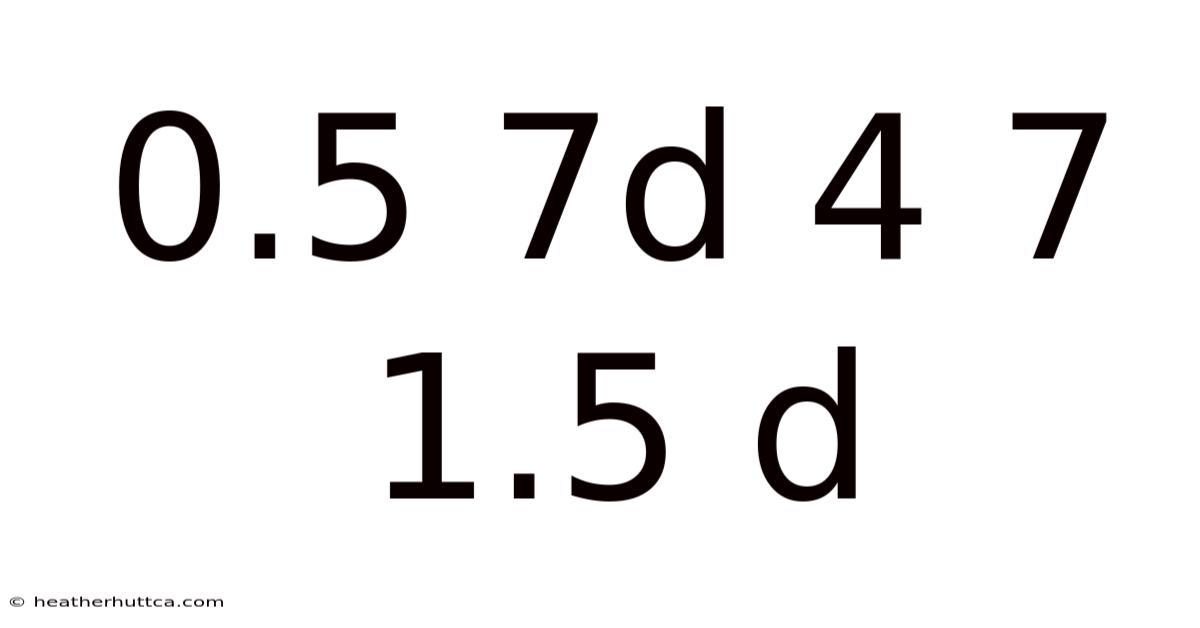
The notation 0.Which means 5 7d 4 7 1. 5 d can appear cryptic at first glance, but it is a compact representation used in various fields to express specific measurements, durations, or parameters. To understand it fully, we must break down each component and explore its possible meanings and applications Worth knowing..
The 0.But 5 in this sequence typically represents a half unit of measurement. This could refer to half a day, half a kilogram, or any other measurement depending on the context. In scheduling or project management, 0.5 often denotes half a day of work or study, indicating that a task or session is expected to take half the standard duration Worth knowing..
Not the most exciting part, but easily the most useful.
7d stands for seven days. This is a common abbreviation in timetables, project plans, and delivery schedules. It signifies a full week, which is a standard cycle in many industries and academic settings. The use of d for days is prevalent in fields such as logistics, construction, and education, where precise time tracking is essential Worth keeping that in mind. Nothing fancy..
The 4 in the sequence is a straightforward numerical value. Depending on the context, it could represent the fourth step in a process, the fourth day of a project, or simply a quantity or count. In educational settings, it might refer to the fourth lesson or module in a curriculum.
Another 7 follows, which, like the first, denotes seven units—most likely days again. The repetition of 7 could indicate two separate periods of seven days each, perhaps representing two phases or cycles in a project or study plan.
Finally, 1.5 d translates to one and a half days. Which means this fractional notation is often used when scheduling or allocating resources, especially when a task or session does not fit neatly into whole-day increments. It allows for precise planning and ensures that time is allocated efficiently.
When these elements are combined, 0.Plus, 5 7d 4 7 1. 5 d could represent a structured timeline or a series of tasks with specific durations. Here's one way to look at it: in an educational or training context, this sequence might outline a module that begins with a half-day introduction, followed by a full week of study, a fourth lesson, another week of study, and concludes with a day and a half of review or assessment.
In scientific or technical fields, such notation is invaluable for clarity and precision. In practice, it allows professionals to communicate complex schedules or procedures succinctly, reducing the risk of misunderstandings. Whether in project management, academic planning, or technical documentation, this kind of notation ensures that all parties have a clear understanding of timelines and expectations That's the part that actually makes a difference. That's the whole idea..
Understanding these abbreviations and their context is crucial for effective communication. 5** as a full day or overlooking the significance of 1.5 d could lead to scheduling errors or resource misallocation. So naturally, misinterpreting a **0. That's why, familiarity with such notation is an essential skill in many professional and academic environments The details matter here..
So, to summarize, the sequence 0.Because of that, 5 d exemplifies the importance of clear and concise communication in scheduling and planning. Plus, by breaking down each component and understanding its meaning, we can appreciate how such notation facilitates efficient organization and execution of tasks across various fields. In real terms, 5 7d 4 7 1. Whether you encounter this in a project plan, a study schedule, or technical documentation, recognizing the significance of each element will help you work through and manage your responsibilities with greater accuracy and confidence.
This structured approach to time notation extends far beyond academic and technical spheres. Think about it: in healthcare, such precise scheduling can determine patient outcomes. A treatment protocol specifying "0.5 7d 4 7 1.5 d" might represent medication administration windows, therapy sessions, or recovery periods—each timing critical to effectiveness It's one of those things that adds up. Less friction, more output..
Project managers similarly rely on these notations to coordinate teams, allocate resources, and set realistic deadlines. The sequence could represent phases of a product launch: initial planning (half day), development sprint (seven days), milestone review (day four), refinement period (another seven days), and final testing (day and a half). This clarity prevents scope creep and ensures stakeholders understand project timelines.
The beauty of such notation lies in its universality. Regardless of industry or role, the fundamental principles remain consistent: clear communication, precise time allocation, and structured planning. These elements form the backbone of successful project execution and professional collaboration.
As workflows become increasingly complex and global teams more distributed, the ability to interpret and use such notation becomes invaluable. It serves as a common language that transcends cultural and disciplinary boundaries, enabling seamless collaboration across diverse contexts Turns out it matters..
The bottom line: whether you encounter this sequence in a corporate setting, educational environment, or technical specification, the underlying principle is clear: organized time management drives successful outcomes. By mastering these notations, you equip yourself with a essential tool for professional excellence and effective planning Nothing fancy..
To implement these practices effectively, individuals and organizations should consider adopting standardized notation guidelines within their teams. This includes creating documentation that clarifies preferred formats, providing training for new team members, and establishing review processes that catch potential timing ambiguities before they cause issues.
Looking ahead, as artificial intelligence and automation increasingly integrate into workplace workflows, the importance of precise time notation will only grow. Smart scheduling systems, AI-driven project management tools, and automated resource allocation platforms all rely on clear temporal data to function optimally. The notation systems we use today provide the foundation for these technological advancements, making basic competency in time expression increasingly vital for future-ready professionals.
What's more, the evolution of remote and hybrid work arrangements has amplified the need for unambiguous scheduling conventions. When teams span multiple time zones and operate across different cultural contexts, standardized notation becomes essential for maintaining coherence and preventing misunderstandings that can arise from ambiguous time expressions Easy to understand, harder to ignore..
For those seeking to improve their proficiency in this area, practice remains key. Reviewing real-world examples from industry publications, technical documents, and project plans will build familiarity with common patterns. Additionally, actively seeking clarification when encountering unfamiliar notation demonstrates professional diligence and prevents costly mistakes.
In closing, the ability to understand and apply precise time notation represents more than a technical skill—it reflects a commitment to clarity, professionalism, and effective communication. Even so, whether managing complex projects, coordinating international teams, or simply organizing personal workflows, these competencies serve as invaluable assets in our time-conscious world. Embrace these practices, and you will find yourself better equipped to meet the demands of modern professional life with confidence and competence And that's really what it comes down to..
This evolution underscores a shift from mere convenience to strategic necessity. Here's the thing — organizations that fail to prioritize this clarity risk operational friction, duplicated efforts, and missed deadlines, particularly in fast-paced, deadline-driven sectors. The true power of these systems lies not just in their ability to record time, but in their capacity to encourage alignment and shared understanding across entire teams It's one of those things that adds up..
The bottom line: the mastery of temporal frameworks is a continuous journey of refinement. Plus, it requires moving beyond passive recognition to active application, where professionals can fluidly translate abstract deadlines into actionable steps. This skill set empowers individuals to handle complex dependencies, negotiate realistic timelines, and manage resources with a precision that minimizes waste and maximizes output That alone is useful..
Looking forward, the integration of these principles with emerging technologies will define the next frontier of productivity. Now, the data structures underpinning our scheduling tools must evolve to handle increasingly complex scenarios, such as predictive analytics and dynamic resource leveling. Those who cultivate a deep, intuitive understanding of how time is represented will be best positioned to put to work these tools, transforming data into decisive strategic advantage.
In essence, the disciplined management of time through standardized notation is no longer just an administrative task. So naturally, it is a core component of organizational resilience and individual expertise. By embedding these practices into the fabric of daily operations, professionals and entities alike check that their efforts are not just busy, but truly effective, paving the way for sustained achievement in an ever-accelerating world It's one of those things that adds up. Turns out it matters..
