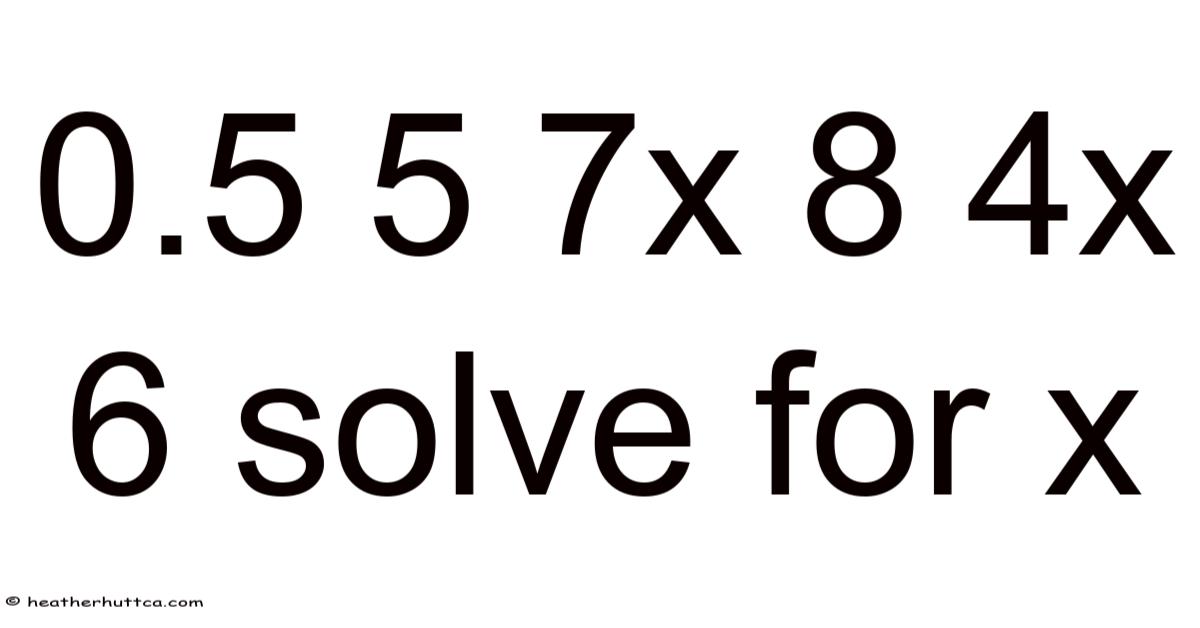
Solving Linear Equations: A Step-by-Step Guide to 0.5(5 + 7x) = 8 + 4x - 6
Linear equations form the foundation of algebra and provide essential tools for solving real-world problems across various fields. In this full breakdown, we'll explore how to solve the equation 0.Even so, 5(5 + 7x) = 8 + 4x - 6 for x, breaking down each step to ensure a thorough understanding of the process. Whether you're a student brushing up on your algebra skills or someone looking to apply mathematical concepts practically, this article will equip you with the knowledge to tackle similar equations confidently.
Understanding the Equation
Before diving into solving 0.5(5 + 7x) = 8 + 4x - 6, it's essential to understand its components. This is a linear equation in one variable (x), meaning it represents a straight line when graphed and contains no exponents higher than 1 Which is the point..
- A left side: 0.5(5 + 7x)
- A right side: 8 + 4x - 6
- The equals sign (=) indicating balance between both sides
Our goal is to find the value of x that makes this equation true, which means finding the point where both sides of the equation have equal value.
Step-by-Step Solution
Let's solve the equation systematically:
Step 1: Simplify Both Sides
First, we'll simplify each side of the equation separately.
Left side: 0.5(5 + 7x) We'll distribute the 0.5 to both terms inside the parentheses: 0.5 × 5 + 0.5 × 7x = 2.5 + 3.5x
Right side: 8 + 4x - 6 We'll combine the constant terms: 8 - 6 + 4x = 2 + 4x
Now our equation looks like: 2.5 + 3.5x = 2 + 4x
Step 2: Isolate Variable Terms
Next, we'll gather all x terms on one side and constant terms on the other.
Subtract 2.Because of that, 5 from both sides: 2. 5 + 3.On the flip side, 5x - 2. 5 = 2 + 4x - 2.5 3.5x = -0.
Now subtract 4x from both sides: 3.5x - 4x = -0.Think about it: 5 + 4x - 4x -0. 5x = -0.
Step 3: Solve for x
Now we have a simple equation with just x: -0.5x = -0.5
Divide both sides by -0.5: x = -0.5 ÷ -0 And that's really what it comes down to..
Verification
To ensure our solution is correct, let's substitute x = 1 back into the original equation:
Left side: 0.5(5 + 7×1) = 0.5(5 + 7) = 0.5(12) = 6
Right side: 8 + 4×1 - 6 = 8 + 4 - 6 = 6
Both sides equal 6, confirming that x = 1 is indeed the correct solution.
Common Mistakes to Avoid
When solving linear equations, several common errors can lead to incorrect solutions:
-
Distribution errors: Forgetting to multiply all terms inside parentheses by the factor outside. As an example, incorrectly calculating 0.5(5 + 7x) as 2.5 + 7x instead of 2.5 + 3.5x.
-
Sign errors: Mishandling negative numbers when moving terms across the equals sign. Remember that subtracting a negative is equivalent to adding a positive.
-
Combining unlike terms: Attempting to combine terms with different variables or a variable with a constant. Here's a good example: 3.5x and 2 cannot be combined directly.
-
Calculation errors: Simple arithmetic mistakes, especially with decimals. Double-check your calculations, particularly when working with fractions or decimals Practical, not theoretical..
Real-World Applications
Solving linear equations isn't just an academic exercise—it has numerous practical applications:
- Finance: Calculating interest, determining loan payments, or analyzing investment growth.
- Physics: Solving problems involving motion, force, or energy.
- Engineering: Designing systems with specific requirements and constraints.
- Data analysis: Finding trends and making predictions based on linear relationships.
- Everyday life: Converting units, calculating discounts, or determining time and distance relationships.
Additional Practice Problems
To reinforce your understanding, try solving these similar equations:
- 0.3(4 + 2x) = 1.2 + 0.6x
- 0.25(8x - 12) = 2x - 3
- 0.75(6 + 3x) = 4.5 + 2.25x
- 0.4(5x - 10) = 2x - 4
For each equation, follow the same steps:
- Now, isolate variable terms
- Simplify both sides
- Solve for x
Conclusion
Mastering the solution of linear equations like 0.In real terms, 5(5 + 7x) = 8 + 4x - 6 is a fundamental skill in algebra and beyond. On the flip side, by following systematic steps—simplifying, isolating variables, and solving—you can confidently tackle a wide range of mathematical problems. Remember to verify your solutions and be mindful of common errors that can lead to incorrect answers That alone is useful..
The ability to solve for x in linear equations opens doors to understanding more complex mathematical concepts and applying mathematical thinking to real-world situations. As you continue to practice, you'll develop not only technical proficiency but also problem-solving strategies that extend far beyond algebra Practical, not theoretical..
Strategies for VerifyingSolutions
After obtaining a value for (x), Make sure you confirm that the answer truly satisfies the original equation. Here's the thing — it matters. But 1. Still, Substitution check – Replace the variable with the computed number in both sides of the equation and simplify. Still, if the two sides are identical, the solution is correct. 2. Estimation inspection – Before performing full arithmetic, a quick mental estimate can reveal whether the result is in the right ballpark.
3. Graphical verification – Plotting the two sides of the equation as separate functions often shows their point of intersection, which corresponds to the solution.
These checks guard against careless sign errors or arithmetic slips that may have occurred during the manipulation stage.
Extending the Method to Systems of Equations
When more than one linear equation involves the same variable, the problem becomes a system. The same systematic approach—simplify, isolate, and solve—can be applied, but additional techniques emerge:
- Substitution – Solve one equation for a variable and substitute the expression into the other equation.
- Elimination – Multiply equations by suitable constants so that adding or subtracting them eliminates a variable, leaving a single‑variable equation.
Mastering these methods expands the range of problems you can tackle, from simple two‑equation systems to larger networks encountered in optimization and economics.
Real‑World Modeling with Multiple Variables
Many authentic scenarios involve more than one unknown. For example:
- Mixture problems – Determining how much of two solutions to combine to achieve a desired concentration.
- Resource allocation – Balancing production limits across several products while meeting demand.
- Travel planning – Relating distance, speed, and time across multiple legs of a journey.
Translating word problems into algebraic form, then applying the linear‑equation strategy, turns a verbal puzzle into a concrete numerical answer.
Resources for Further Practice
- Textbooks – Look for chapters titled “Linear Equations” or “Algebraic Solutions” in any standard high‑school algebra text.
- Online platforms – Interactive sites provide step‑by‑step feedback and generate random problems for unlimited practice.
- Video tutorials – Visual walkthroughs can clarify the reasoning behind each manipulation, especially when dealing with fractions or negative coefficients.
Regular engagement with these resources reinforces procedural fluency and builds confidence in handling increasingly complex equations Most people skip this — try not to..
Concluding Thoughts
The ability to isolate a variable, simplify expressions, and verify results forms the backbone of algebraic problem solving. By consistently applying a clear, step‑by‑step routine and remaining vigilant about common pitfalls, learners can approach not only straightforward equations but also multi‑step and system‑based challenges with assurance. So continued practice, coupled with thoughtful review, transforms a foundational skill into a versatile tool for tackling real‑world quantitative problems. Keep solving, keep checking, and let each successful solution deepen your mathematical intuition.
